

I’m going to be real with you. When I first heard about SmutFinder, I rolled my eyes.
Another AI writing tool. Another platform promising “personalized stories” that would probably read like a blender ate a romance novel and spit out the chunks in random order. I’ve tested enough AI tools to know that most of them are mediocre at best and embarrassing at worst — especially when it comes to fiction.
But the numbers made me curious. Over 430,000 monthly visitors. More than 24,800 authors creating on the platform. Featured on 50+ AI directories. A subreddit with active users posting about their experiences. For a platform that barely anyone in mainstream tech talks about, those aren’t small numbers.
So I gave it a week. One story per night. Different tropes, different settings, different heat levels. Here’s what happened — the good, the bad, and the stuff that genuinely caught me off guard.
Night 1: The Setup
The first thing I noticed is that SmutFinder doesn’t waste your time.
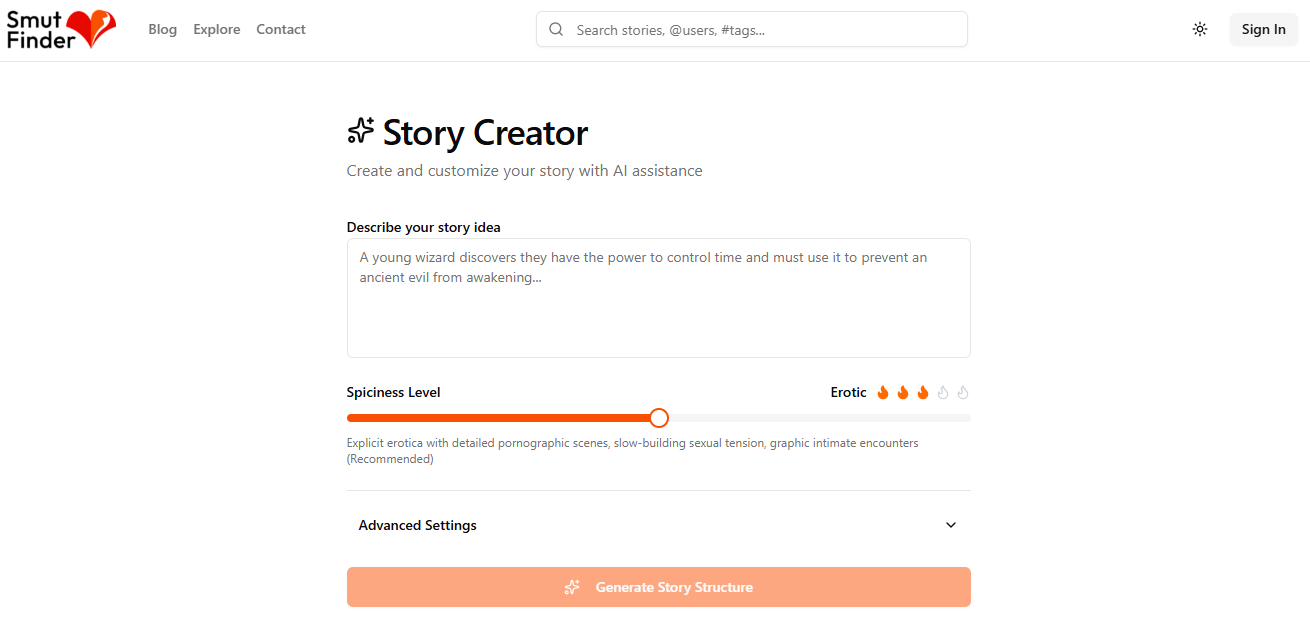
There’s no 15-minute onboarding tutorial. No quiz about your “writing personality.” No email verification wall before you can do anything. You land on the create page and the interface gives you exactly what you need: mood, setting, characters, tropes, intensity. Pick your options. Hit generate. Story appears.
My first story took about 45 seconds from landing on the site to reading the opening paragraph. I picked enemies to lovers, office setting, medium heat. The kind of scenario I’ve read a hundred times in published books.
The result was… better than I expected. Not perfect. But better than I expected.
The dialogue sounded like two people who actually disliked each other — not two robots performing “dislike” from a script. The tension built in a way that felt paced, not rushed. And when the scene shifted from hostility to something else, the transition didn’t feel forced.
Was it as good as a published novel? No. Was it better than what I’ve gotten from general AI tools? Significantly.
Night 2: Testing the Trope Intelligence
This is where I started paying closer attention. I wanted to know if SmutFinder actually understood tropes or if it was just using the words as decoration.
I generated a forced proximity story — two strangers, a cabin, a snowstorm. The standard setup. What I was looking for was whether the AI understood the emotional mechanics of forced proximity: the awkwardness of sharing space, the gradual erosion of personal boundaries, the moment where proximity stops being uncomfortable and starts being something else.
It got it. Not flawlessly — there was a section in the middle where the characters warmed up to each other a bit too quickly. But the bones were right. The structure was right. The AI understood that forced proximity isn’t about the cabin. It’s about the inability to escape what you’re feeling when you can’t escape the person.
I tested three more tropes that week: slow burn, grumpy sunshine, and dark romance. Each one followed the emotional arc that defines the trope. Slow burn actually burned slowly. The grumpy character was genuinely grumpy — not just mildly inconvenienced. And the dark romance had real edge to it, not the watered-down version that mainstream AI tools produce when they’re trying not to offend anyone.
Night 3: The Heat Level Spectrum
Let’s talk about the thing everyone actually wants to know about.
SmutFinder lets you control the spiciness level on a 5-pepper slider. I tested the full range across multiple nights.
At the lower end — sweet, closed-door romance — the stories focused on emotional connection, longing, the first kiss. No explicit content. Just feelings. Honestly, some of these were my favorites of the entire week. The AI wrote tenderness well.
At the middle — steamy but not graphic — the intimate scenes were present but not overwhelming. Descriptive enough to feel real, restrained enough to feel tasteful. This is where most readers probably live, and the AI handles it confidently.
At the high end — full explicit erotica — the gloves came off. And this is where SmutFinder’s specialization shows most clearly. General AI tools either refuse to go here or produce content that reads like it was written by someone who has technically read the Wikipedia entry on intimacy but never experienced it. SmutFinder’s explicit content reads like it was written by someone who has actually read romance and erotica — because the model was trained on it.
The prose in explicit scenes had rhythm. It had pacing. Characters reacted like people, not mannequins. The language was direct without being clinical. Was every sentence perfect? No. But the hit rate was higher than anything I’ve seen from a general-purpose AI.
Night 4: The Explore Section
I spent night four not creating stories but reading what other people had created.
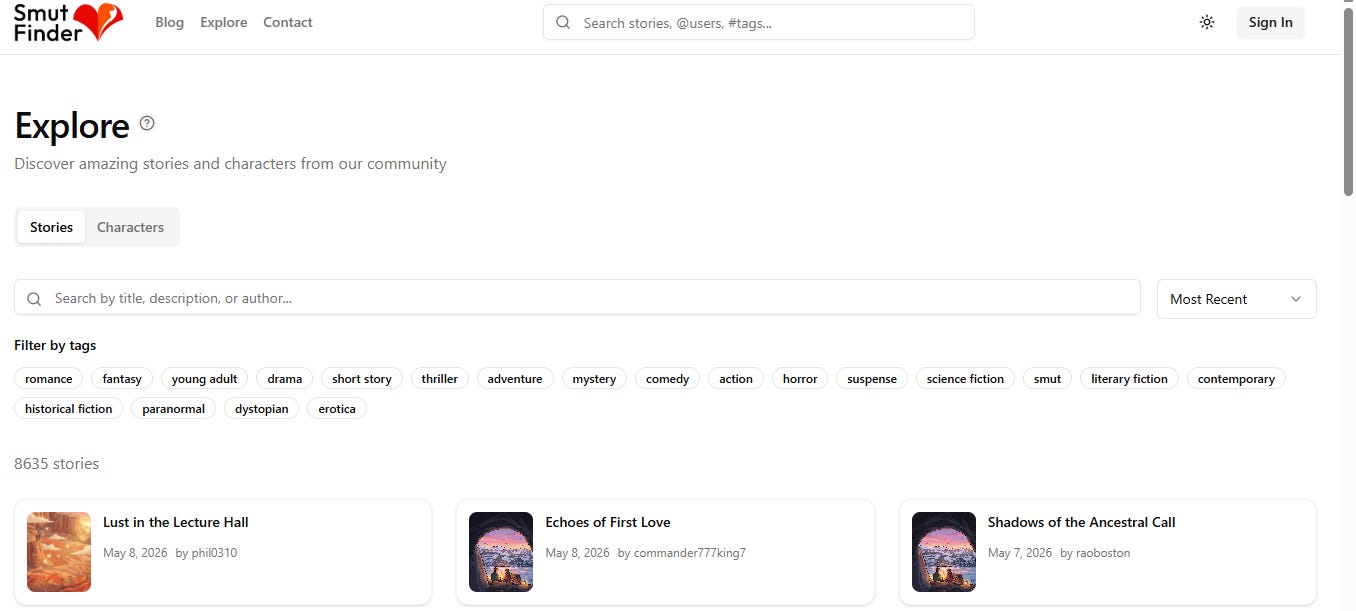
SmutFinder’s Explore section is where users can publicly share their generated stories. Think of it as a community library organized by genre, trope, and mood. You can browse, read, and get inspired by what 24,800+ authors have built on the platform.
What struck me was the variety. There were sweet, wholesome romance stories next to intense dark erotica. Fantasy worldbuilding next to contemporary workplace settings. Quick one-shots next to longer, more developed narratives.
It’s also a surprisingly good discovery tool. If you’re not sure what trope or setting to try, browsing Explore for ten minutes gives you more ideas than staring at the create page ever will. I found at least three scenarios I’d never have thought of on my own.
Night 5-7: What I Noticed Over Time
By night five, the novelty had worn off. And that’s when I started noticing things more clearly.
What works really well:
The trope execution is the standout feature. SmutFinder understands the emotional structure behind each trope better than any AI tool I’ve tested. It doesn’t just use trope names as keywords — it follows the actual narrative arc that makes each trope work.
The speed is remarkable. A full story in under 60 seconds. For anyone who has ever spent 45 minutes browsing Kindle Unlimited trying to find the right book — this solves that problem instantly.
The customization depth is genuine. You’re not picking from three generic options. You control mood, setting, character dynamics, tropes, and intensity. The output reflects your choices in ways that feel specific, not templated.
Privacy is taken seriously. SmutFinder uses industry-standard encryption and states clearly that personal information is never shared with third parties. For a platform where people are creating deeply personal content, this matters more than most users probably realize.
And it’s free. Genuinely free. No paywall after three stories. No “premium features” locked behind a subscription. No credit card required.
What could be better:
Character depth has a ceiling. The AI creates characters that serve the story well, but they rarely surprise you. They don’t have contradictions, quirks, or the kind of internal messiness that makes fictional people feel truly alive. They’re well-drawn archetypes, not fully realized humans.
Long-form stories lose coherence. SmutFinder excels at short-form — complete stories that run a few thousand words. When I tried to push toward longer narratives, the plot threads started loosening and the character consistency softened. This is an AI limitation across the board, not specific to SmutFinder, but worth noting.
Who Should Try SmutFinder (And Who Shouldn’t)
Try it if:
You’re a romance reader who knows exactly what you want — specific trope, specific mood, specific heat level — and you’re tired of scrolling through books that almost match but never quite get there.
You’re a writer who needs a brainstorming partner for scenes and scenarios. Several authors on writing forums use tools like SmutFinder to draft scenes before rewriting in their own voice. It’s a starting point, not a final product.
You’re curious about a trope, genre, or scenario you haven’t explored before. Fiction is the safest place to test boundaries, and SmutFinder makes that experimentation private and instant.
You’re a couple looking for a creative way to explore fantasies together. More people use AI fiction tools for this than anyone openly admits.
Skip it if:
You want a conversational AI companion. SmutFinder generates stories, not back-and-forth chat. It's a story generator, not a chatbot. (If chat-style roleplay is what you're after, my guide to the best Character AI alternatives covers ten options built exactly for that.)
You expect published-novel quality. The output is good for AI — often surprisingly good. But it’s not going to replace your favorite author. It’s a different experience, not a substitute for one.
You’re under 18. The platform is adults only. They enforce age restrictions, as they should.
The Verdict After 7 Nights
SmutFinder is the best AI tool I’ve used for romance and erotic fiction. That’s not a high bar to clear — most AI tools are terrible at this — but SmutFinder clears it by a meaningful margin.
The trope intelligence is real. The heat level control works. The prose quality is above average for AI-generated fiction. The privacy measures are appropriate. And the fact that it’s completely free makes the value equation simple: there’s nothing to lose by trying it.
It won’t replace human-written fiction. It won’t give you the experience of falling in love with an author’s voice over 300 pages. But it will give you a personalized story that matches your exact preferences, in under a minute, at 2 AM when no bookstore is open and no author is taking requests.
For what it is, it’s genuinely well-built. And for the audience it serves — romance and erotica readers who want specificity, privacy, and instant access — there’s nothing else quite like it right now.
Have you tried SmutFinder? What was your experience — good, bad, or weird? Reply here. I read every response, and I’ll share the most interesting ones (anonymously) in next week’s post.