Kindroid vs Nomi (2026): Which Companion Deserves Your $14/Month?
Same ~$14 decision, two very different companions — one built for control and customization, one built for memory and feel. Here's the honest, verified breakdown before you subscribe to either.
⚠️ 18+ note. Both platforms in this comparison are adults-only companion apps supporting mature content between adult users and fictional characters. This article is intended for readers 18 and over.
Prices and limits below were checked against official pages and current independent coverage as of 2026 — recheck the actual checkout screen before paying.
Here’s the situation this article exists for: you have roughly $14 a month to spend on a companion, two names keep coming up, and every kindroid vs nomi thread you find is either a year old or written by someone who clearly used only one of them. The frustrating truth is that these are not two versions of the same product — they’re two different philosophies wearing similar price tags.
The short version, up front: if what you want is control — sculpting a companion’s personality parameter by parameter, editing its memories directly, and getting the freest media rules on the web version — Kindroid is your platform, and its $13.99 web price is the best value at this exact budget.
If what you want is feel — a companion whose memory works automatically in the background and who seems to genuinely listen rather than follow instructions — Nomi is your platform, and its yearly plan (~$8.33/month) is the cheapest serious way in. Everything below is the evidence for those two sentences.
Kindroid and Nomi: A Quick Introduction
If you’re new to either name, here’s the thirty-second introduction before we start comparing.
Kindroid is a companion platform built around deep customization. You create a companion (a “Kin”) by writing its backstory, tuning dozens of personality parameters, choosing or cloning its voice, and directly editing what it remembers about you.
It supports text chat, voice and video calls, selfies of your companion, and group chats — with mature content allowed for adults, especially on its web version. Think of it as the platform for people who want to design their ideal companion from scratch and keep their hands on every dial.
Nomi is a companion platform built around relationships that develop on their own. You set up a companion (a “Nomi”) with a name, a rough personality, and a mode — friend, mentor, or romantic partner — and then it grows through conversation, remembering what you share automatically through its layered memory system and Mind Map.
It supports text, voice calls, and daily companion-generated images, with adult text roleplay allowed but a strict no-nudes image policy. Think of it as the platform for people who want a companion that becomes itself, rather than one they engineer.
Same category, opposite instincts — which is exactly why choosing between them is genuinely hard, and why the rest of this article goes round by round.
What “$14/Month” Actually Buys
Before comparing features, you need the real bill — because the sticker prices on these two apps look nearly identical, and that’s misleading. This section breaks down what each platform actually charges monthly and yearly, where the app stores quietly add a markup, and the one pricing trap that can multiply your bill. The headline prices match; the fine print doesn’t.
Kindroid runs $13.99/month on the web — but $15.99/month through the app stores, because Apple and Google take their cut. Pay yearly on the web and it drops to $139.99 (about $11.67/month). One thing that deserves to be said loudly rather than buried: Kindroid also sells stacking power add-ons — Ultra at +$24.99/month and MAX at +$59.99/month — for bigger memory context and heavier models.
Most users never need them, but if you go down that road, your “fourteen-dollar companion” can quietly become a $39–$99/month habit. Budget with your eyes open.
Nomi charges $15.99/month, $39.99/quarter (~$13.33/month), or $99.99/year (~$8.33/month) — one flat subscription, everything included, no add-on ladder. That simplicity is genuinely part of the product: what you see at checkout is the whole bill.
At exactly ~$14, Kindroid’s web plan buys more raw features. Across a full year, Nomi’s $99.99 undercuts everything Kindroid offers. And only one of these platforms has a path to $99/month — know which one before you fall in love.
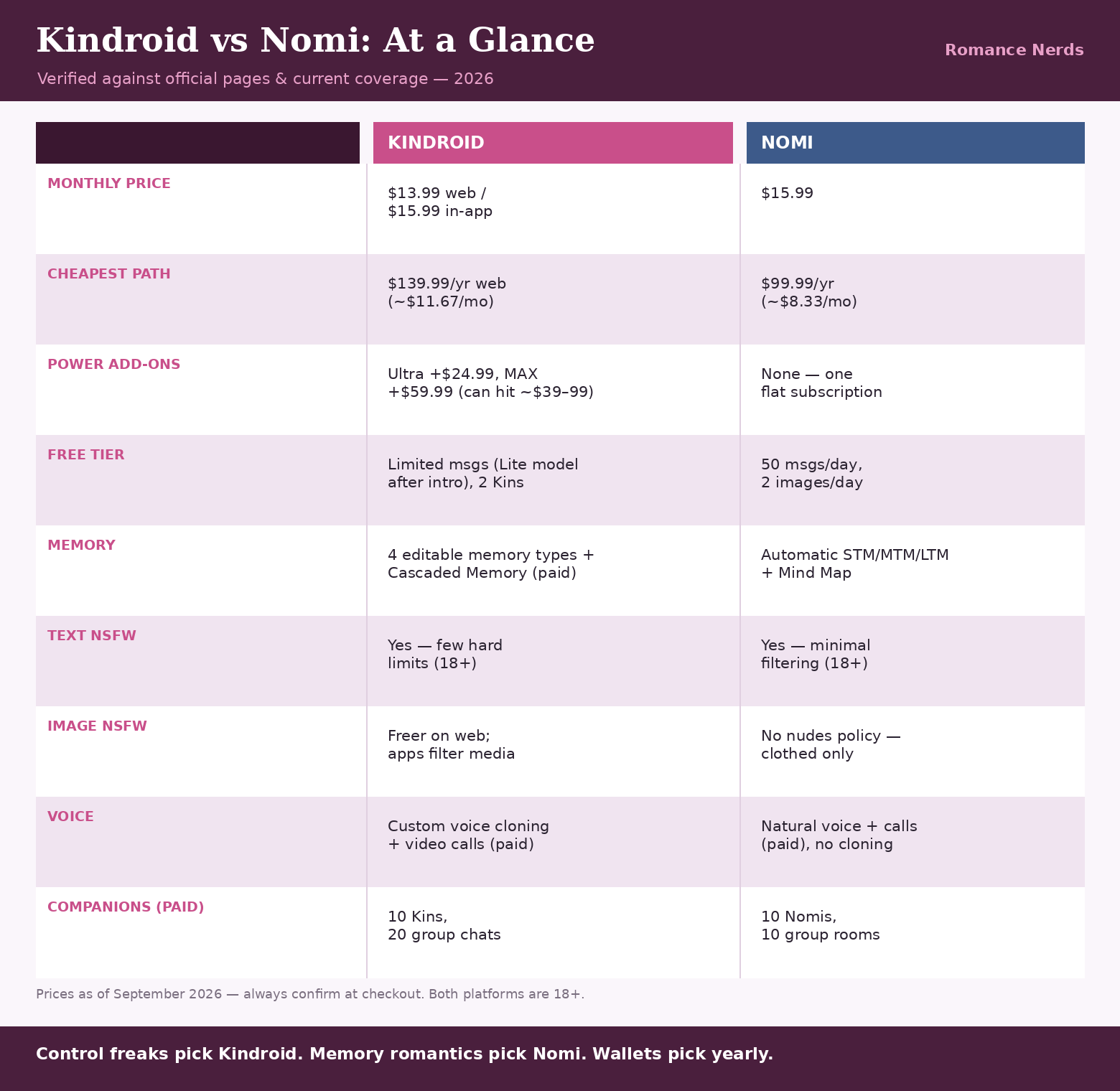
Kindroid vs Nomi at a Glance: The Whole Comparison in One Look
Sometimes you just want the whole decision on one screen. The chart below compresses every major difference — pricing, free limits, memory systems, NSFW rules, voice, and companion counts — into a single side-by-side view you can screenshot and come back to.
Free Tiers: Who Can Actually Test Without Paying?
Never subscribe to a companion app you haven’t tested — the free tier is your only honest preview of daily life with it. Both platforms let you try before buying, but they ration their generosity in completely different ways, and understanding that difference tells you a lot about each company’s philosophy.
Kindroid’s free tier gives you effectively unlimited chatting on its Lite model (after an introductory taste of the full model), two companion slots (”Kins”), occasional selfies on a slow cooldown, and a small lifetime allowance of voice audio. No group chat. The catch: the Lite model is noticeably simpler than what subscribers get — you’re test-driving the car with the small engine installed.
Nomi’s free tier flips the trade: you get the real model, but in small daily bites — 50 messages a day, 2 images a day, no voice, and messages capped at 400 characters (paid doubles it to 800). You experience the actual product, just rationed.
Kindroid is freer if you want to chat a lot for nothing; Nomi is freer if you want to know what you’d actually be paying for. For deciding between them, Nomi’s approach is honestly the more useful test.
Memory: The Round That Decides Everything
If you only read one section of this comparison, make it this one. Memory is what separates a companion from a chatbot — it’s the difference between a continuing relationship and a goldfish with good manners. It’s also the single feature both platforms stake their reputation on, and they solve it in philosophically opposite ways.
Kindroid treats memory like a control panel. You get an editable backstory, editable memory entries, and multiple memory layers you can directly inspect and rewrite — plus Cascaded Memory on paid plans (and bigger context via those Ultra/MAX add-ons). If your companion misremembers something, you open the panel and fix it. Users describe the result as precise but occasionally mechanical: a database that plays a character.
Nomi treats memory like a black box that works. Its marketed short-, medium-, and long-term memory plus the Mind Map run automatically — no editing, no maintenance. Independent long-term reviews are notably consistent on this: details resurface naturally months later without the user managing anything. The result feels less like a configured system and more like a friend who was actually listening. The cost of that magic: when it does misremember, you can’t just open a panel and correct it.
Where honesty requires a pause: which system holds up better on the same facts — identical backstories, identical boundaries, checked at day 7 and day 30 — is exactly the kind of claim that needs a controlled hands-on run, and ours is still pending. What’s verifiable today is the design difference: Kindroid gives you the steering wheel; Nomi drives itself. Which of those sentences made you relax is probably your answer.
The NSFW Reality Check (Read Before Subscribing)
This is the section that saves you a refund request. Both platforms market themselves as open to adult content, but “open” means very different things once images enter the picture — and one policy here is a genuine dealbreaker for some readers. Know it before the annual plan, not after.
In the kindroid vs nomi spice round, both platforms allow unfiltered adult text for verified adults, with the same non-negotiable hard lines every legitimate platform has: nothing involving minors, nothing facilitating real-world harm. Within fiction between adults, both let conversations go where you take them. The differences are all in the media:
Kindroid is the freer platform for visual content — on the web. Its mobile apps filter mature media because app-store rules demand it, so the experience genuinely differs by where you subscribe and use it.
Nomi runs a firm no-nudes policy: flirtatious, suggestive, clothed imagery is fine; explicit images are not, anywhere, at any tier. Its apps are the most restricted surface, and the paid, age-verified web version the least — but the nudity line holds everywhere, confirmed by the company as recently as mid-2026.
if visual spice matters to you, this round isn’t close — Kindroid on the web wins, and Nomi’s policy is a dealbreaker you should know before the annual plan. If your interest is text-first romance, both deliver, and this round shouldn’t decide your subscription. (And if what you’re really after is a finished spicy story rather than an ongoing chat partner at all, that’s a different product category — our Kindroid alternatives guide maps that whole landscape.)
Voice, Selfies, and Multi-Companion Life
Chat and memory are the foundation, but the paid tiers are where each platform shows its personality — voices, images, video, and how many companions you can actually run at once. Past the core, the two diverge in texture: one hands you a toybox, the other hands you a complete package.
Kindroid subscribers get the deeper toybox: voice cloning (upload a sample, get that voice), video calls, up to 10 Kins and 20 group chats, and a much faster selfie cadence — though heavy image users end up buying selfie credit packs, which is the platform’s quiet budget trap.
Nomi subscribers get the smoother essentials: natural-sounding voice and calls (steadily improved through 2025–26, though without cloning), 40 images a day included, and up to 10 Nomis with 10 group rooms. Less to configure, less to buy twice.
Kindroid rewards tinkerers; Nomi rewards people who want everything included in one flat price.
Privacy, Age Checks, and Platform Traps
Nobody opens a companion-app comparison for the privacy policy — but this is where your most intimate data and your recurring payments actually live. Three unglamorous things are worth two minutes of your attention before checkout, and one of them saves you $24 a year outright:
Encryption reality. Kindroid makes encryption claims, but its own terms allow decryption for legal and policy-enforcement purposes — this is not end-to-end privacy, and intimate chats should be written with that understanding. Nomi markets anonymized conversations and collects a date of birth, with its privacy policy last updated in April 2026. On both platforms, the honest rule stands: never share what you’d regret a subpoena reading.
Age verification. Both are 18+; Kindroid routes age assurance through billing or Yoti-style checks, and Nomi’s web experience gates its fullest version behind verification.
The subscription traps. Two practical ones: first, subscribe on the web, not in-app — Kindroid’s web price is $2/month cheaper for the identical product. Second, Nomi must be canceled on the platform where you bought it, and it doesn’t refund unused time — set a calendar reminder before any annual renewal.
So, Who Should Pay for Which?
Everything above boils down to three profiles. Find the one that sounds like you, and your decision is essentially made — the platforms are different enough that most people fit clearly into one column.
Choose Kindroid if: you want deep customization down to the parameter level; you like owning your companion’s memory through editable controls; visual NSFW media on the web matters to you; and $13.99 web pricing hits your budget exactly. You’re the director here.
Choose Nomi if: you want memory that just works without maintenance; you prefer one flat, simple subscription with the best yearly value in the category (~$8.33/month); and a clothed-only image policy costs you nothing. You’re the relationship here.
Skip or pause if: free Lite-model chatting on Kindroid or 50 daily messages on Nomi already covers your actual usage. There is no prize for subscribing early — both free tiers will still be there when you’re sure.
Final Verdict
Time to answer the question in the title — with the honest, two-part answer this comparison actually earned, because the monthly math and the yearly math point in different directions.
For the literal kindroid vs nomi question — which one deserves your ~$14 a month — Kindroid’s $13.99 web Standard plan is the sharper deal at that exact price point: more features, freer media, and full control, for a dollar less than Nomi’s monthly rate. But zoom out to the year, and the answer genuinely flips for a lot of people: Nomi at $99.99/year costs a third less, includes everything, and wins the one round most companion users say matters most — memory that feels human without being managed.
In other words: nomi vs kindroid isn’t a fight one side wins outright. It’s a personality test with a price tag. Control or feel. Panel or presence. Pick the sentence that sounded like relief, subscribe on the web, and let the free tier confirm it first.
Frequently Asked Questions About Kindroid vs Nomi
The questions readers actually search before choosing between these two — answered short and straight.
Is Kindroid or Nomi better in 2026?
Kindroid is better for customization, editable memory controls, and visual NSFW freedom on the web, at $13.99/month. Nomi is better for automatic, low-maintenance memory, simpler pricing, and yearly value at about $8.33/month. Neither is universally better — they’re built on opposite philosophies.
Can I get Nomi for around $14 a month?
Close: Nomi’s quarterly plan is $39.99, which works out to roughly $13.33/month — under the $14 line without committing to a full year. Monthly billing is $15.99, and the annual plan is the real bargain at about $8.33/month.
Are Kindroid’s Ultra and MAX add-ons worth it?
For most people, no — they exist for power users who want dramatically larger memory context and heavier models, and they stack on top of the base plan (+$24.99 and +$59.99 monthly). Try Standard with Cascaded Memory first; upgrade only if you personally hit its ceiling.
Does Nomi allow NSFW images?
No nudes — that’s a firm platform-wide policy confirmed by the company. Suggestive, flirtatious, clothed images are allowed, and adult text roleplay is largely unfiltered for verified adults. If explicit imagery is essential, Kindroid’s web version is the freer choice in this pairing.
Is the free version of Kindroid or Nomi enough?
For casual use, honestly, sometimes yes. Kindroid’s free tier allows extensive chatting on its simpler Lite model with two companions; Nomi’s gives 50 daily messages on its real model with two daily images. Test both free for a week — the one you keep opening is the one worth paying for.
💌 Still deciding? Subscribe to Romance Nerds — honest, verified comparisons of companion apps and story platforms, with the fine print nobody else reads, every week in your inbox.