

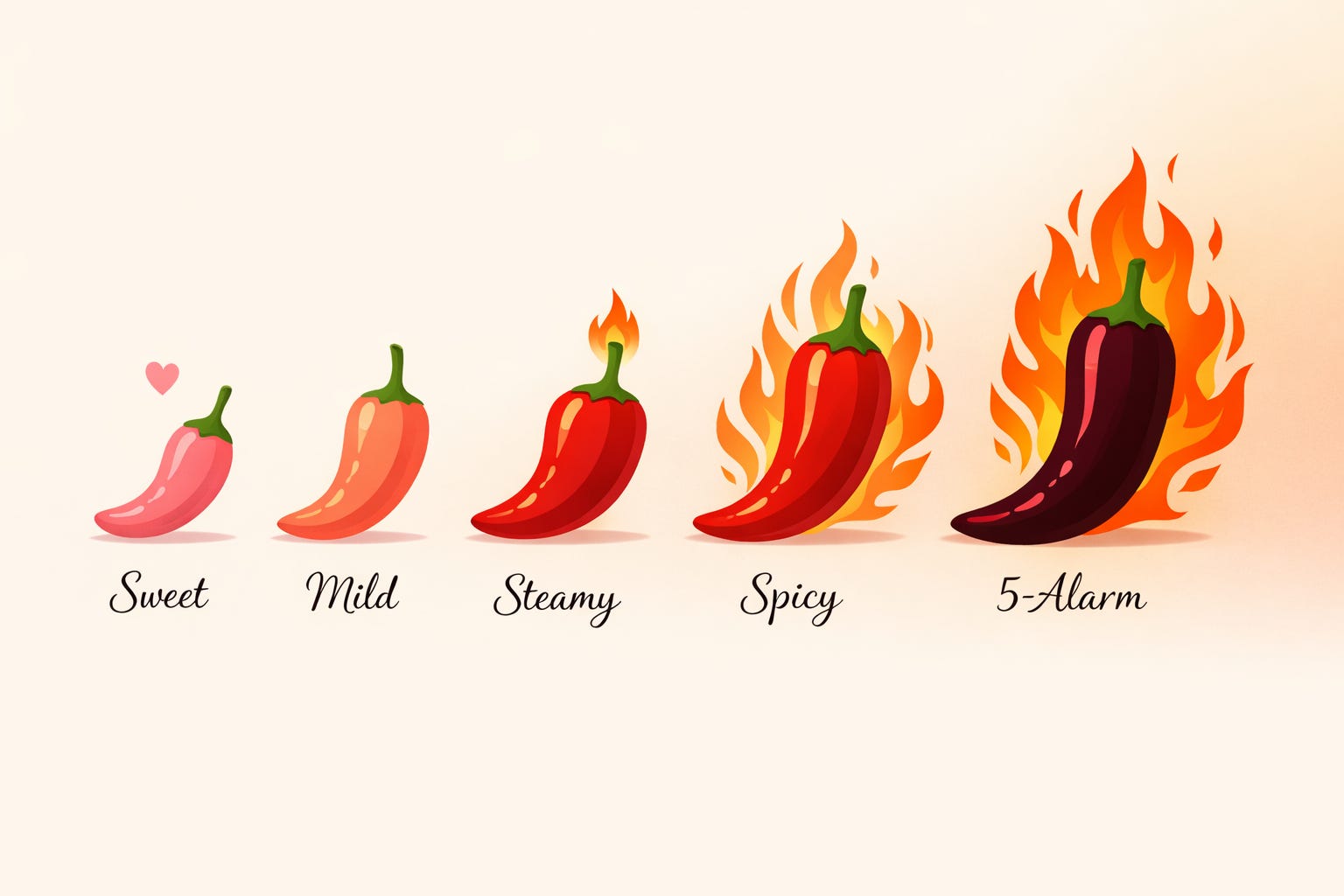
If you have spent any time on BookTok in the past two years, you have encountered the pepper emoji. One pepper. Three peppers. Five peppers with a fire emoji and a warning to “not read this in public.”
The romance spice scale has become the unofficial language of modern romance readers. It is how we signal what we want, what we can handle, and what we are secretly hoping for at midnight when nobody is watching. But despite how casually we throw around spice ratings, most readers have never seen them properly defined — and the definitions that do exist vary wildly depending on who you ask.
This guide fixes that. We are going to break down every level of the romance spice scale, from the gentlest closed-door kiss to the kind of content that would make your grandma clutch her pearls and possibly faint. And then we are going to talk about something nobody else has written about yet: how AI story tools are letting readers skip the search entirely and generate stories at their exact preferred spice level, on demand.
Let us start with the basics.
What is The Romance Spice Scale?
The romance spice scale is a reader-created rating system that measures how much sexual or intimate content appears in a book. Think of it as a heat guide — the same way a restaurant menu marks dishes from mild to extra hot, the spice scale tells you what level of intimacy to expect before you commit to 400 pages.
The scale typically runs from 0 or 1 (no sexual content at all) to 5 (extremely explicit, frequently, and in detail). Most readers and reviewers use chili pepper emojis, fire emojis, or simple numbers to communicate where a book falls.
There is no official, standardized spice rating system. That is important to understand. The same book can be rated a 3 by one reader and a 5 by another, depending on their personal threshold. What feels “extra spicy” to someone who primarily reads sweet romance might feel “moderately warm” to someone who lives in the dark romance section of Kindle Unlimited.
But even without standardization, the community has developed a surprisingly consistent vocabulary. Here is how it actually breaks down.
The Romance Spice Scale: Every Level Explained
Level 0-1: Sweet Romance (no spice)
This is the closed-door, Hallmark-movie end of the spectrum. Characters fall in love through emotional connection, witty banter, and meaningful gestures. Physical intimacy might include hand-holding, a chaste kiss, or a hug that lingers a beat too long.
There are no sexual scenes on the page. If intimacy happens, it happens entirely off-page — the chapter ends with a kiss and picks up the next morning. The reader fills in whatever blanks they choose (or none at all).
Sweet romance is not “less than” other levels. It is a deliberate craft choice that focuses entirely on emotional intimacy. The tension comes from longing, vulnerability, and the slow build of trust — not from physical escalation.
What readers search for at this level: “clean romance,” “sweet romance,” “closed door romance,” “no spice romance books.”
Reader profile: Readers who prefer emotional depth without explicit content. This includes readers of faith-based romance, readers who are newer to the genre, and experienced romance readers who simply prefer this style.
Level 2: Mild Spice (Behind Closed Doors)
At level 2, physical attraction is acknowledged and sometimes described — but the “door closes” before anything explicit happens. You might get a passionate kiss described in some detail, or a scene where the tension is clearly sexual, but the author cuts away before clothes come off.
The phrase “fade to black” belongs here. The characters’ desire for each other is real and present in the narrative, but the author chooses to imply rather than describe. You know what happened. You just were not in the room when it did.
What readers search for at this level: “fade to black romance,” “low spice romance,” “mild spice books,” “2 pepper romance.”
Reader profile: Readers who want romantic tension and the acknowledgment that the characters are physically attracted to each other, but prefer the intimate details left to imagination.
Level 3: Moderate Spice (The Door is Open)
This is where the door swings open and the reader is present for at least one intimate scene. The language is descriptive but not clinical — you get enough detail to understand what is happening without a step-by-step anatomy lesson.
Level 3 is often considered the “sweet spot” by many romance readers. There is enough physical intimacy to feel satisfying, but the emotional story still drives the plot. The intimate scenes serve character development — they reveal vulnerability, deepen trust, or create complications. They are not just there for heat.
Authors at this level tend to use a mix of direct and metaphorical language. You will read sentences that describe physical sensations, but the prose stays grounded in emotional experience.
What readers search for at this level: “medium spice romance,” “3 pepper books,” “steamy romance,” “open door romance.”
Reader profile: The largest segment of romance readers. People who want both emotional investment and physical intimacy as part of the love story.
Level 4: High Spice (Bring a Fan)
Now we are getting into territory where the intimate scenes are frequent, detailed, and central to the reading experience. Level 4 books typically contain multiple explicit scenes with specific language — body parts are named, acts are described, and the prose does not shy away from graphic detail.
The key distinction between level 4 and level 5 is that at level 4, the story still has substantial plot beyond the intimate scenes. The romance and the spice are intertwined, but you could describe the book’s plot without it being “they had a lot of sex.” The characters have arcs. The conflict has stakes. The spice enhances the story rather than replacing it.
This is the territory of authors like Tessa Bailey, Ana Huang, and Hannah Grace. Fantasy romance authors like Sarah J. Maas and Rebecca Yarros also frequently land here, blending elaborate worldbuilding with scenes that require you to put the book down and take a breath.
What readers search for at this level: “spicy romance books,” “4 pepper romance,” “high spice BookTok,” “very steamy romance.”
Reader profile: Experienced romance readers who want substantial heat alongside strong plotting. This is the BookTok heartland — the level that generates the most recommendation videos, the most “I read this in public and had to stop” reactions, and the most intense fandom discourse.
Level 5: Extra Hot (You Have Been Warned)
Level 5 is explicit, frequent, adventurous, and unapologetic. The intimate content is a primary feature of the reading experience. Scenes may include kink, BDSM dynamics, taboo scenarios, power play, or other elements that push beyond conventional romance.
At this level, the line between romance and erotica starts to blur — though the distinction matters. Romance at level 5 still centers a love story and typically delivers a happily-ever-after or happy-for-now ending. Erotica may or may not include that emotional arc. The presence of a love story is what keeps a 5-pepper book in the romance category.
Dark romance lives here. So does paranormal romance with supernatural intensity, monster romance, and the subset of BookTok that uses the phrase “the full banana” without flinching.
Content warnings become essential at this level. What one reader finds thrilling, another might find triggering. Responsible authors and reviewers flag specific content so readers can make informed choices.
What readers search for at this level: “5 pepper romance,” “dark romance books,” “extra spicy books,” “spicy BookTok recommendations,” “erotica romance,” “smut books.”
Reader profile: Readers who specifically seek intense, explicit content as part of their reading experience. This is a massive and growing audience — the word “spicy” appeared in nearly 52,000 BookTok posts in recent tracking periods, and dark romance is one of the fastest-growing subgenres in publishing.
Why the Spice Scale Matters More Than Ever
Romance is the dominant force in fiction right now. US print romance sales hit 51 million units in the most recent twelve-month tracking period, with year-to-date sales up 24 percent. Around 59 million print book sales in 2024 were directly tied to BookTok content. The 2026 State of Reading Report found that 54 percent of readers cited stress relief as their primary reason for reading more.
In a market this large and this emotionally driven, the spice scale is not a gimmick. It is infrastructure. It is how millions of readers navigate an ocean of content to find exactly what serves their mood, their comfort level, and their specific emotional needs on any given night.
The spice scale matters because it respects reader agency. Nobody should be surprised by content they did not expect or want. And nobody should have to search through dozens of books to find the heat level that matches their taste. The scale shortens that search.
But even with the scale, there is a fundamental limitation: books are fixed objects. An author writes at one heat level. The book is what it is. A reader who wants a level 3 version of a level 5 book — or a level 5 version of a level 2 book — is out of luck. The story exists in one configuration.
That is exactly where AI is entering the conversation.
How AI Tools Are Changing The Romance Spice Scale
Here is the shift that nobody in traditional publishing is talking about yet.
A growing number of romance readers are not just searching for books at their preferred spice level. They are generating stories at their preferred spice level, on demand, using AI tools that let them set the heat before the first word is written.
The concept is simple. Instead of hoping an author wrote the exact combination of tropes, characters, and spice you want, you tell an AI tool what you want and it creates it for you. Enemies to lovers, fae court setting, slow burn, he falls first — and three peppers. Or five peppers. You decide.
This is not hypothetical. A 2025 fandom survey found that 34 percent of active fanfic writers had used AI tools in some part of their writing process. The number of readers who use these tools purely for personal consumption — generating stories they never share — is almost certainly much larger.
SmutFinder is one of the tools built specifically around this concept. Its interface mirrors how romance readers already think about the spice scale: you select your mood, set your characters, choose your tropes, and — critically — pick your heat level before the story generates. It is the spice scale turned into an input dial rather than an output label.
The experience maps directly onto the rating system outlined above. A reader who knows she wants a level 3 story gets a level 3 story. Not a level 2 that she wishes were warmer, or a level 5 that overshoots her comfort zone. The exact temperature she requested.
Other tools exist in this space too. General AI assistants like ChatGPT can handle sweet romance but block anything above a level 2. Specialized platforms like Sudowrite target authors writing full manuscripts and offer heat level controls through creativity sliders. DreamPress focuses on interactive stories with adjustable intensity.
But for the reader — not the writer — who simply wants to read a tailored story at her chosen spice level, the tools that win are the ones that reduce friction. SmutFinder reduces it to almost zero: pick your vibe, set your spice, read your story. The interface is essentially a visual spice scale with a generate button attached.
What This Means For How We Read Romance
The romance spice scale started as a community shorthand — a way for readers to communicate preferences. It has evolved into something bigger: a framework for personalized fiction.
When a reader can articulate “I want a level 3 forced proximity romance with a grumpy-sunshine dynamic and a happy ending,” she is not just describing a book preference. She is writing a prompt. The vocabulary of the spice scale has become the input language for AI-generated fiction.
This does not replace books. The readers generating AI stories are the same people buying three paperbacks a week. They are not reading less. They are supplementing — filling gaps between releases, exploring tropes their favorite authors have not written yet, and satisfying very specific moods that no existing book quite matches.
If anything, the spice scale becomes more important in an AI-assisted reading world, not less. The scale is what makes the tools work. Without a shared vocabulary for heat levels, there would be no way to calibrate the output. The spice scale is the operating system. AI tools are applications running on it.
How to Find Your Spice Level
If you are new to romance or unsure where you fall on the scale, here is a simple framework:
Start by asking yourself what you want from the intimate moments in a story. Do you want the emotional tension without the physical detail? Start at level 1-2. Do you want to be present for the intimate scenes but prefer the focus on feelings over mechanics? Try level 3. Do you want detailed, explicit scenes that make your pulse quicken? Level 4-5 is your territory.
There is no wrong answer. There is no “correct” spice level. The entire purpose of the scale is to help you find what brings you joy — and to skip what does not.
Check reader reviews on Goodreads and BookTok for spice ratings. Sites like romance.io offer steam ratings submitted by readers. And if you want to experiment with different heat levels without committing to a full book, AI tools like SmutFinder let you test-drive the spectrum in minutes. Generate a level 2 story. Then a level 4. See what resonates.
Your spice level is personal. It might change based on your mood, your day, or the phase of the moon. The scale is not a permanent label. It is a compass.
The Spice Scale is Here to Stay
The romance spice scale is one of the most effective reader-created tools in publishing history. It emerged organically from community need. It spread through social media. It became embedded in how publishers market books, how reviewers frame recommendations, and how readers discover their next read.
Now it is becoming the interface for AI-generated fiction too. The same vocabulary that helps you filter AO3 tags or search BookTok recommendations is the vocabulary that powers personalized story generation.
Whether you are a one-pepper reader or a five-pepper reader — or somewhere gloriously in between — the scale exists to serve you. Use it. Share your ratings. Help other readers find their comfort zone. And if you ever want a story written at your exact heat level, on your exact terms, the tools to do that now exist.
The spice scale gave us a language for what we want. AI gave us a way to get it. Romance readers, as always, figured out both first.
If you enjoyed this deep dive, you might also like: What 17 Million Fanfics Tell Us About What Romance Readers Actually Want — the data behind why fluff, angst, and hurt/comfort dominate reader preferences.