

By Alma Martin · Trope guide · October 2026
Disclosure: This guide mentions one AI story tool comparison once, near the end. Some tools on this site have affiliate links, and if you sign up through one I may earn a commission at no extra cost to you. Nothing in my tier list is sponsored.
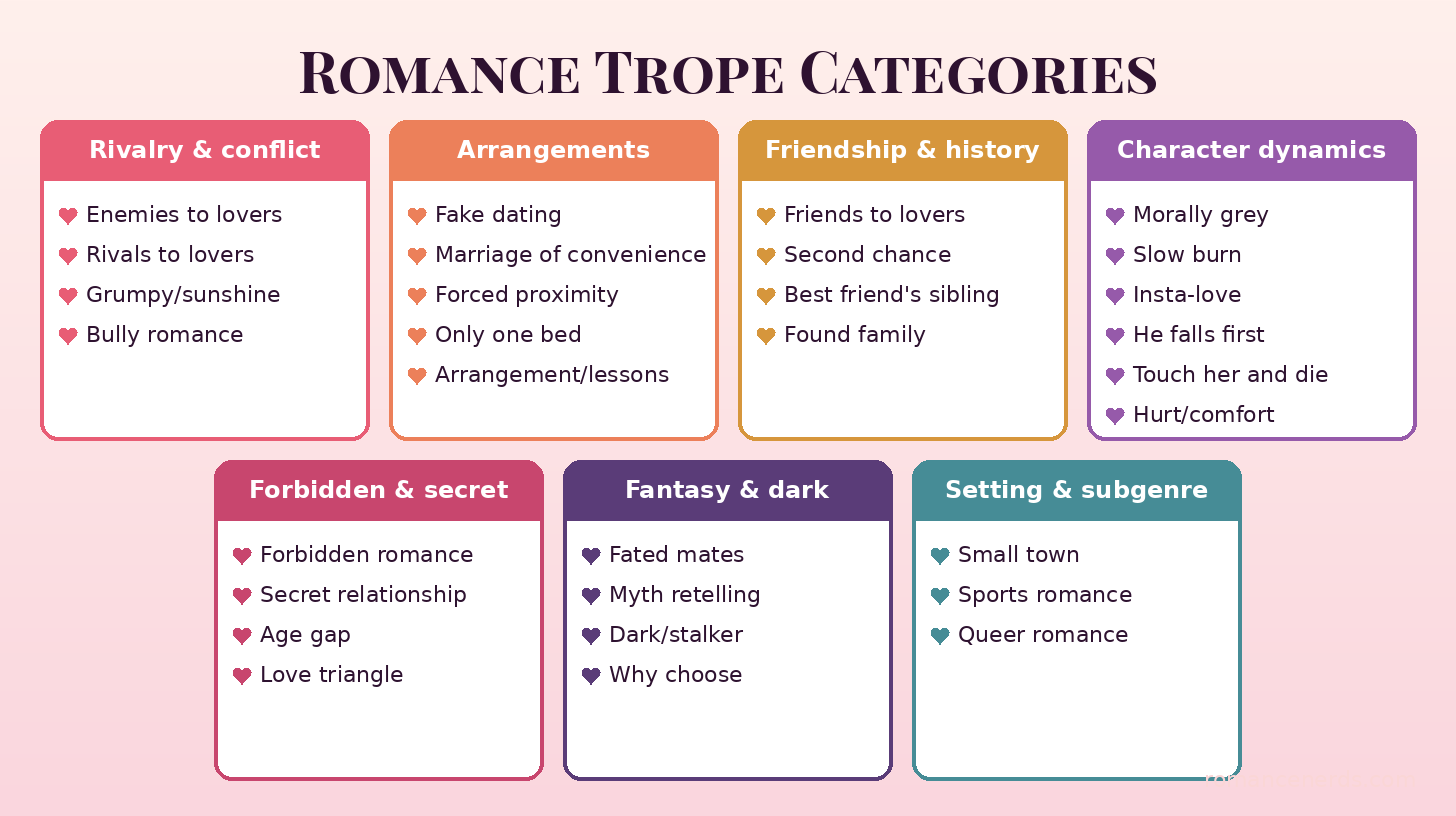
What are the most popular romance tropes? Going by reader surveys and BookTok, they’re enemies to lovers, friends to lovers, forbidden romance, fake dating, forced proximity, grumpy/sunshine, slow burn and second chance. In a January 2025 survey of 2,000 U.S. romance readers, the top three were forbidden romance (45%), friends to lovers (44%) and enemies to lovers (42%). Below I explain 30 tropes, grouped by category. For each one I cover what it means, why readers love it, and how spicy it usually gets. Then I give you my personal tier list, from S to C.
A trope is just a familiar story pattern, and I don’t think “tropey” is an insult. Readers use tropes to find exactly the feeling they’re after, the way you’d pick a playlist. This page is meant as a hub: bookmark it, argue with my rankings, and use it to find your next read.
Key takeaways
30 romance tropes, grouped into rivalry, arrangements, friendship and history, character dynamics, forbidden, fantasy and dark, and setting tropes.
Survey favorites: forbidden (45%), friends to lovers (44%) and enemies to lovers (42%), from a 2025 ThriftBooks/Talker Research survey.
Least liked in that survey: love triangles (23%), office romance (22%) and fake dating (21%).
Heat ranges are typical, not fixed. Every trope shows up from sweet to five peppers.
My S tier: enemies to lovers, slow burn, forced proximity, grumpy/sunshine and morally grey. That’s my opinion; yours may differ.
What Are Romance Tropes (and What’s a Microtrope)?
A romance trope is a recurring setup or dynamic that readers recognize instantly: two rivals forced to work together, a fake relationship that turns real, one bed at the inn. A trope isn’t a formula for the whole book. It’s the promise of a particular kind of tension.
A microtrope is a smaller beat inside a book, like “he falls first,” “touch her and die,” “only one bed” or “he gives her his jacket.” Microtropes are what readers mean when they ask for something very specific, and they’re why BookTok descriptions read like ingredient lists.
Two things to keep in mind:
Tropes stack. Most books combine two to four, such as enemies to lovers plus forced proximity plus slow burn.
Tropes aren’t spice levels. A trope tells you the shape of the romance, and the romance spice scale tells you how explicit it gets. I give a typical heat range for each trope below using that scale’s 1–5 peppers.
The Most Popular Romance Tropes in 2026
The best public data I’ve found is a Talker Research survey of 2,000 U.S. romance readers, commissioned by ThriftBooks (January 2025):
Most loved: forbidden romance (45%), friends to lovers (44%), enemies to lovers (42%).
Least loved: love triangles (23%), office romances (22%), fake dating (21%).
That last result surprised me, because fake dating is everywhere on BookTok. My guess is that it’s a trope people either adore or have read too many times. It’s another reminder that “popular” and “universally loved” aren’t the same thing. If you’re curious why these dynamics hit so hard in the first place, I dig into the psychology in why women read romance novels.
Rivalry and Conflict Romance Tropes
1. Enemies to Lovers
What it is: Two people who genuinely dislike or oppose each other slowly fall in love.
Why readers love it: Every argument is foreplay for the moment the hostility turns into honesty. It’s also one of the survey’s top three tropes.
Heat range: 🌶️ to 🌶️🌶️🌶️🌶️🌶️. It works at every level.
Examples: Pride and Prejudice by Jane Austen; The Hating Game by Sally Thorne.
Want to write one? My enemies-to-lovers prompts are a good place to start.
2. Rivals to Lovers
What it is: Enemies to lovers’ friendlier cousin. The two are competing for the same job, title or prize, but don’t necessarily hate each other.
Why readers love it: Competence is attractive, and watching two equals push each other is thrilling.
Heat range: 🌶️🌶️ to 🌶️🌶️🌶️🌶️.
Examples: Not Another Love Song by Julie Soto (orchestra rivals); Heated Rivalry by Rachel Reid (hockey rivals).
3. Grumpy/Sunshine
What it is: A guarded, prickly character falls for a warm, optimistic one.
Why readers love it: The grump is soft only for one person, which is a small version of the “being the exception” fantasy.
Heat range: 🌶️ to 🌶️🌶️🌶️🌶️.
Example: The Love Hypothesis by Ali Hazelwood (Adam and Olive).
4. Bully Romance
What it is: One character torments the other, often at school or college, before a romance develops.
Why readers love it: Readers describe the intensity and the redemption arc as the draw. It’s also one of the most divisive tropes, so check content warnings.
Heat range: 🌶️🌶️🌶️ to 🌶️🌶️🌶️🌶️🌶️.
Arrangement Romance Tropes
5. Fake Dating
What it is: Two people pretend to be a couple for a wedding, a family, or their reputations, and the feelings become real.
Why readers love it: Every “for show” touch means more than either of them admits.
Heat range: 🌶️ to 🌶️🌶️🌶️🌶️.
Examples: The Spanish Love Deception by Elena Armas; The Duke and I by Julia Quinn (a sham courtship).
6. Marriage of Convenience / Arranged Marriage
What it is: They marry (or get engaged) for money, politics or family, then fall in love.
Why readers love it: All the intimacy of marriage, with none of the emotional security yet.
Heat range: 🌶️🌶️ to 🌶️🌶️🌶️🌶️🌶️.
Examples: King of Wrath by Ana Huang; Bride by Ali Hazelwood (a vampire-werewolf political marriage).
7. Forced Proximity
What it is: Circumstances trap them together, whether that’s a shared office, a flat, a cabin or a road trip.
Why readers love it: There’s no escape from the tension, and it has to break eventually.
Heat range: 🌶️ to 🌶️🌶️🌶️🌶️🌶️.
Examples: The Flatshare by Beth O’Leary (they share a flat and a bed on alternate schedules); Wildfire by Hannah Grace (summer-camp counselors).
8. Only One Bed
What it is: The classic forced-proximity microtrope. There’s one bed, and someone offers to sleep on the floor.
Why readers love it: It’s pure, delicious awkwardness, and it often forces the first honest conversation.
Heat range: 🌶️ to 🌶️🌶️🌶️🌶️🌶️.
9. Arrangement or Lessons
What it is: A deal to teach, practice or “help” with dating or intimacy that turns emotional.
Why readers love it: It’s a safe excuse for closeness, with built-in consent conversations.
Heat range: 🌶️🌶️🌶️ to 🌶️🌶️🌶️🌶️🌶️.
Example: The Kiss Quotient by Helen Hoang.
Friendship and History Romance Tropes
10. Friends to Lovers
What it is: Long-time friends realize they’re in love.
Why readers love it: Total emotional safety plus the terror of risking it all. It came second in the survey.
Heat range: 🌶️ to 🌶️🌶️🌶️🌶️.
Examples: People We Meet on Vacation by Emily Henry; The Cheat Sheet by Sarah Adams.
11. Second Chance Romance
What it is: Former partners get another shot.
Why readers love it: There’s history, regret, and the question of whether they’ve grown enough this time.
Heat range: 🌶️ to 🌶️🌶️🌶️🌶️.
Example: Happy Place by Emily Henry (exes pretending they’re still together).
12. Best Friend’s Sibling
What it is: Falling for your best friend’s brother or sister.
Why readers love it: The friendship is at stake, and the secrecy adds a forbidden edge.
Heat range: 🌶️🌶️ to 🌶️🌶️🌶️🌶️.
Example: Wild Love by Elsie Silver.
13. Found Family
What it is: A group of misfits becomes each other’s real family, often with a romance at the center.
Why readers love it: It’s comfort, belonging and banter.
Heat range: 🌶️ to 🌶️🌶️🌶️ (usually gentler).
Example: Legends & Lattes by Travis Baldree (cozy fantasy).
Character Dynamic Romance Tropes
14. Morally Grey Love Interest
What it is: A love interest who lives by a personal code rather than society’s rules, with darkness for the world and devotion for one person.
Why readers love it: Being the exception. I wrote a whole guide on morally grey characters.
Heat range: 🌶️🌶️🌶️ to 🌶️🌶️🌶️🌶️🌶️.
Examples: A Court of Mist and Fury by Sarah J. Maas (Rhysand); Fourth Wing by Rebecca Yarros (Xaden).
15. Slow Burn
What it is: The romance takes a long time to happen, sometimes most of the book (or series).
Why readers love it: The payoff feels earned, and the yearning is the point.
Heat range: 🌶️ to 🌶️🌶️🌶️🌶️🌶️. The burn is about pacing, not explicitness.
Example: Pride and Prejudice by Jane Austen.
16. Insta-Love
What it is: Instant, overwhelming attraction or love at first sight.
Why readers love it: It’s fast, intense and wish-fulfilling, though plenty of readers find it unearned.
Heat range: 🌶️ to 🌶️🌶️🌶️🌶️🌶️.
17. He Falls First
What it is: A microtrope where the hero realizes his feelings long before the heroine does.
Why readers love it: Watching someone pine for you is a powerful fantasy.
Heat range: Any.
18. Touch Her and Die
What it is: A possessive-protective microtrope in which the love interest is violently protective of one person.
Why readers love it: It makes devotion visible. It often travels with morally grey heroes.
Heat range: 🌶️🌶️🌶️ to 🌶️🌶️🌶️🌶️🌶️.
19. Hurt/Comfort
What it is: One character is hurt, physically or emotionally, and the other cares for them.
Why readers love it: You get angst and softness in the same scene. It’s also one of the biggest tags on AO3, which I explore in what 18 million fanfics tell us.
Heat range: 🌶️ to 🌶️🌶️🌶️🌶️.
Forbidden and Secret Romance Tropes
20. Forbidden Romance
What it is: Something serious stands in the way: rules, family, status, rival kingdoms.
Why readers love it: Wanting what you can’t have. It was the survey’s #1 trope at 45%.
Heat range: 🌶️ to 🌶️🌶️🌶️🌶️🌶️.
Example: Be With Me by Gabrielle Sands (a forbidden mafia romance).
21. Secret Relationship
What it is: The couple has to hide their relationship from the press, their families or their teams.
Why readers love it: Stolen moments feel more charged.
Heat range: 🌶️🌶️ to 🌶️🌶️🌶️🌶️.
Example: Red, White & Royal Blue by Casey McQuiston (the president’s son and a British prince).
22. Age Gap
What it is: A significant age difference between leads (adults only).
Why readers love it: Experience versus fresh perspective, often with a forbidden flavor. Readers differ a lot on how big a gap works for them.
Heat range: 🌶️🌶️ to 🌶️🌶️🌶️🌶️🌶️.
23. Love Triangle
What it is: One person is torn between two love interests.
Why readers love it (or don’t): Some readers enjoy the high drama, but it was the least liked trope in the 2025 survey (23%).
Heat range: Any.
Fantasy and Dark Romance Tropes
24. Fated Mates
What it is: A paranormal or fantasy bond that says these two are destined.
Why readers love it: The certainty is part of the appeal, and so is fighting the bond.
Heat range: 🌶️🌶️🌶️ to 🌶️🌶️🌶️🌶️🌶️.
25. Mythology Retelling
What it is: Romance built on myths or fairy tales, like Hades and Persephone or Beauty and the Beast.
Why readers love it: A familiar shape with a new twist.
Heat range: 🌶️🌶️ to 🌶️🌶️🌶️🌶️🌶️.
Example: Neon Gods by Katee Robert (a modern Hades and Persephone).
26. Dark Romance / Stalker Romance
What it is: Romance with dark themes such as obsession, captivity or violence. It’s dark-grey territory.
Why readers love it: The intensity, experienced safely inside fiction. I always say check content warnings.
Heat range: usually 🌶️🌶️🌶️🌶️ to 🌶️🌶️🌶️🌶️🌶️.
Example: Haunting Adeline by H.D. Carlton (heavy warnings). For more, see my spiciest books list.
27. Why Choose / Reverse Harem
What it is: One heroine and several love interests, and she doesn’t have to pick.
Why readers love it: Maximum devotion, no love-triangle heartbreak.
Heat range: usually 🌶️🌶️🌶️🌶️ to 🌶️🌶️🌶️🌶️🌶️.
Example: Den of Vipers by K.A. Knight (dark, heavy warnings).
Setting and Subgenre Romance Tropes
28. Small-Town Romance
What it is: A cozy town, nosy neighbors and a slower pace of life.
Why readers love it: Comfort and community, plus everyone watching the couple fall in love.
Heat range: 🌶️ to 🌶️🌶️🌶️🌶️.
Example: When in Rome by Sarah Adams.
29. Sports Romance
What it is: At least one lead is an athlete, often in hockey, football or skating.
Why readers love it: Discipline, teamwork, and a lot of physical confidence.
Heat range: 🌶️🌶️ to 🌶️🌶️🌶️🌶️🌶️.
Examples: Icebreaker by Hannah Grace; Heated Rivalry by Rachel Reid.
30. Queer Romance (M/M, F/F, BL)
What it is: Romance between two men, two women, or other LGBTQ+ pairings. That’s a category rather than a single trope, but it’s one many readers filter by.
Why readers love it: Every trope above, told through stories that have long been underrepresented. For the manga and webcomic side, see my BL vs Yaoi guide.
Heat range: 🌶️ to 🌶️🌶️🌶️🌶️🌶️.
Examples: Heartstopper by Alice Oseman (sweet); Red, White & Royal Blue by Casey McQuiston.
My Romance Tropes Tier List (S, A, B, C)
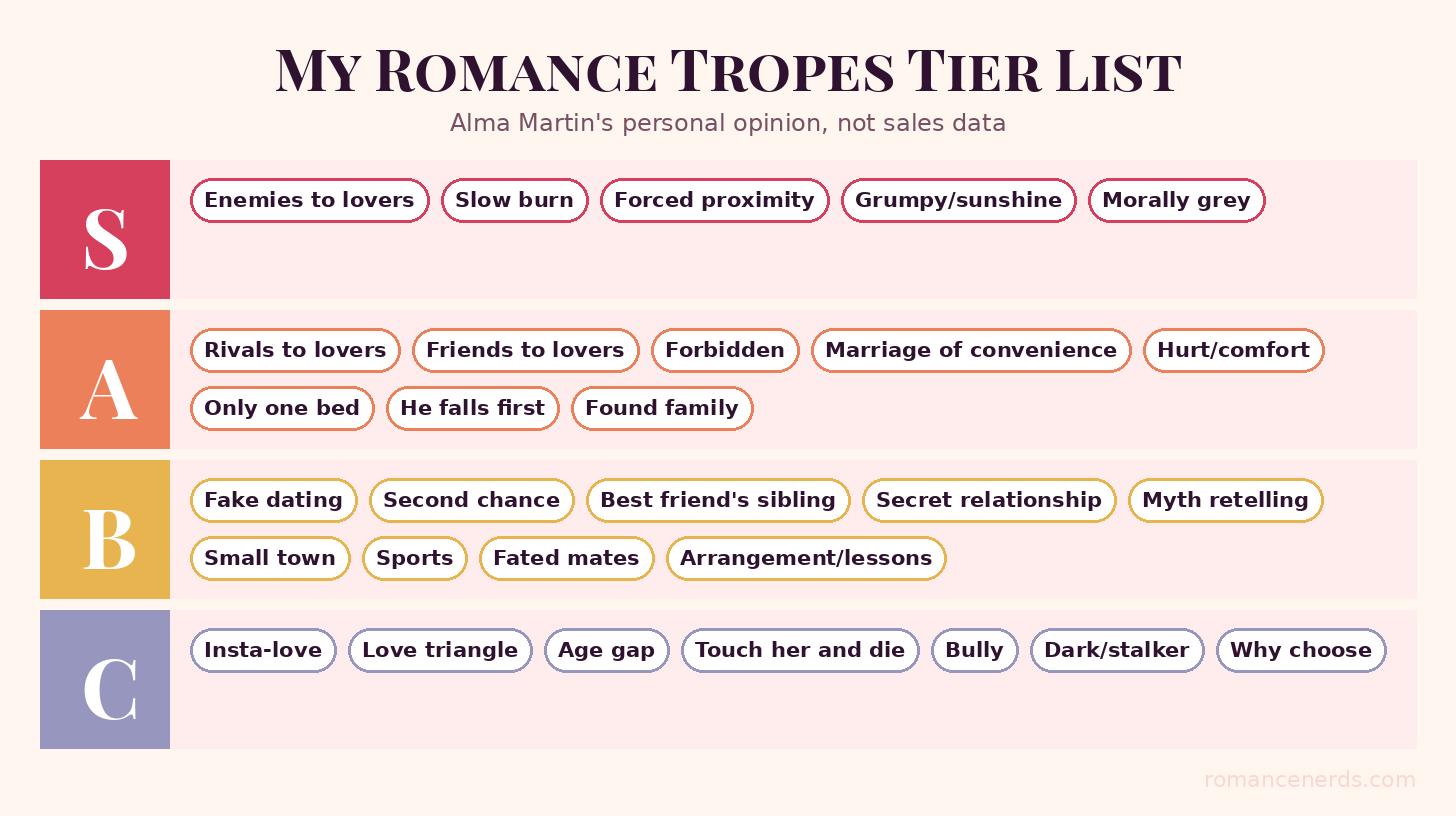
This is my personal opinion, based on what I most enjoy seeing done well, not on sales data. Tiers say nothing about quality: a C-tier trope in the right author’s hands can still be a favorite book.
S tier: the ones I’ll always click on
Enemies to lovers
Slow burn
Forced proximity
Grumpy/sunshine
Morally grey love interest
A tier: reliably great
Rivals to lovers
Friends to lovers
Forbidden romance
Marriage of convenience / arranged marriage
Hurt/comfort
Only one bed
He falls first
Found family
B tier: love it when it’s done well
Fake dating
Second chance romance
Best friend’s sibling
Secret relationship
Mythology retelling
Small-town romance
Sports romance
Fated mates
Arrangement / lessons
C tier: it depends heavily on the book for me
Insta-love
Love triangle
Age gap
Touch her and die
Bully romance
Dark / stalker romance
Why choose / reverse harem
Queer romance (#30) isn’t in the tiers on purpose. It’s a category that contains every trope above, not a dynamic to rank.
Some notes on my reasoning:
Why slow burn is S tier for me: a payoff that’s been building for 300 pages is the most satisfying feeling romance offers me.
Why fake dating is only B for me: I love it when the “fake” boundaries are clear and the slip into real feelings is gradual. When the pretense is flimsy, it loses me. (The 2025 survey suggests I’m not alone; it was among the least liked.)
Why dark romance is C for me: that’s not a judgment on readers who love it. It’s the trope where execution and content warnings matter most, so it’s the one I’m most cautious recommending.
How Romance Tropes Combine: My Favorite Pairings
Tropes are best in combination. These are the stacks I personally find hardest to resist:
Enemies to lovers + forced proximity: nowhere to hide from someone you claim to hate.
Grumpy/sunshine + he falls first: the grump has been gone for her since chapter one.
Marriage of convenience + slow burn: married on paper, falling for each other in real time.
Friends to lovers + only one bed: the night the friendship can’t pretend anymore.
Morally grey + touch her and die: the darkness pointed outward, the devotion pointed at her.
How to Find Books by Trope
Goodreads and StoryGraph: search “[trope] romance” lists and shelves, and StoryGraph also lets you filter by mood and pace.
romance.io: it lists reader-submitted tropes and steam ratings for many books.
BookTok: search the trope name plus “books” (e.g., “only one bed books”).
AO3: filter fanfiction by tags like “Enemies to Lovers,” “Slow Burn” or “Hurt/Comfort.”
Write your own: some AI story tools let you pick tropes as inputs. I compare a few neutrally in SmutFinder vs Smitten Stories vs DreamGen.
FAQ: Romance Tropes
What is the most popular romance trope?
In a 2025 ThriftBooks/Talker Research survey of 2,000 U.S. romance readers, forbidden romance topped the list (45%), just ahead of friends to lovers (44%) and enemies to lovers (42%).
What is a trope in romance?
A trope is a familiar story pattern or dynamic, like enemies to lovers or fake dating, that tells readers what kind of romantic tension to expect.
What’s the difference between a trope and a microtrope?
A trope shapes the whole romance (e.g., fake dating). A microtrope is a smaller beat within it (e.g., only one bed, he falls first).
What is the least popular romance trope?
In that same survey, readers most disliked love triangles (23%), office romances (22%) and fake dating (21%).
What does “slow burn” mean in romance?
The relationship develops gradually, and the first kiss or confession comes late in the book. It’s about pacing, not spice level.
Are romance tropes a bad thing?
No. Tropes help readers find the experience they’re craving. What matters is execution: a familiar trope written with fresh characters can feel brand new.
What romance tropes are spicy?
Any trope can be sweet or spicy. Dark romance, why choose and fated mates tend to run hotter. Check a book’s spice rating separately; my spice scale guide explains the levels.
What’s the difference between enemies to lovers and rivals to lovers?
Enemies genuinely dislike or oppose each other. Rivals compete for the same thing but may respect each other from the start.
Your Turn
Tropes are a shared language, and tier lists are made to be argued with. Tell me your S tier, or which trope you think I’ve badly underrated. If you want to start writing your own, my enemies-to-lovers prompts are a fun place to begin.
💌 Subscribe to Romance Nerds for trope guides, book lists by heat level, and more of my opinions you can argue with.
Sources
Talker Research / ThriftBooks romance reader survey (January 2025): https://talkerresearch.com/study-reveals-men-bigger-fans-of-romance-than-women/
Example books were checked against publisher, author or Goodreads pages, and the All About Romance 2026 Top 100 poll: https://allaboutromance.com/2026-poll/