

⚠️ 18+ note. This post discusses adult reading genres and is intended for readers 18 and over.
Quick answer: Smut and erotica both feature explicit, on-the-page sex — the difference is what the story is built around.
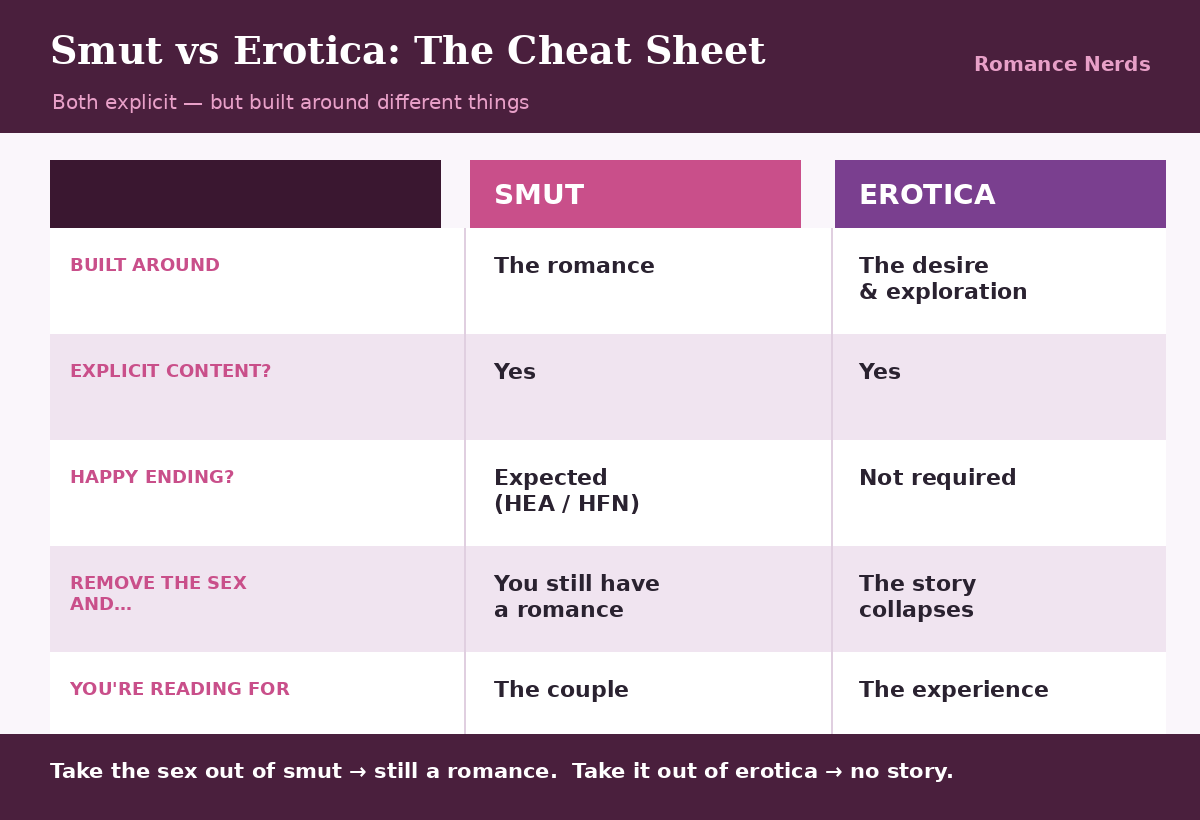
Smut is romance-first: the relationship is the point, the sex serves the love story, and you’re all but promised a happily-ever-after.
Erotica is desire-first: the sexual journey and exploration are the point, the emotional arc revolves around that, and a happy ending isn’t required. Put simply — take the sex out of smut and you still have a romance; take the sex out of erotica and the story falls apart. Neither is “better.” They just scratch different itches.
If you spend any time on BookTok or in bookish corners of the internet, you’ve seen these two words thrown around constantly — often as if they mean the exact same thing. “Smut,” “erotica,” “spicy,” “steamy,” all blurred together in the comments of the same viral book video. And honestly? In casual conversation, the overlap is fine. Nobody’s checking your definitions at the door.
But there is a real difference, and once you see it, you’ll never un-see it — it’ll make you better at finding books you’ll actually love and skipping the ones that aren’t your thing. So let’s clear it up properly: no snobbery, no “well, actually,” just a plain-English map of where smut ends and erotica begins, and why the line is blurrier than the purists admit.
If you already know your way around the romance spice scale, think of this as the next layer up: spice tells you how explicit a book is; smut vs erotica tells you what the explicit content is in service of.
The One-line Difference
Here’s the whole thing in a sentence, and then we’ll unpack it:
Smut = a romance with explicit sex scenes. The love story leads; the heat supports it.
Erotica = explicit sex with a story woven around it. The desire leads; the plot supports it.
That’s the core. Everything else is nuance. But the nuance is where the confusion lives, so let’s go deeper.
What “Smut” Actually Means
Smut is romance where the bedroom door stays wide open. At its heart, a smutty book is a romance novel — with all the things romance readers love: the meet-cute or the tension, the emotional push-and-pull, the character growth, and crucially, the happily-ever-after (HEA) or at least a happy-for-now. The explicit scenes are a major feature, but they’re in service of the relationship.
A few things worth knowing about the word itself:
It started as an insult. “Smut” was long used to dismiss romance as lowbrow trash. Readers — the overwhelming majority of them women — have proudly reclaimed it. Today, calling yourself a “smut reader” is a badge, not a confession.
It’s used interchangeably with “spicy romance,” “steamy romance,” and “explicit romance.” When someone says a book is smutty, they usually mean the romance goes all the way rather than fading to black.
The relationship is load-bearing. Take the sex scenes out of a smut novel and you’d still have a recognizable love story underneath — thinner, but intact.
Think Katee Robert, Sierra Simone, or the spicier end of BookTok’s favorites. The sex is explicit and central, but you’re there for the couple.
What “Erotica” Actually Means
Erotica is writing built to explore desire itself. Here, the sexual journey — the fantasies, the kinks, the exploration, the sensual experience — is the primary point of the story, not a subplot within a romance. There’s usually still a plot, characters, and emotional depth (that’s what separates erotica from pornography, which just depicts acts), but everything is arranged around the sexual arc rather than a love arc.
Key distinctions:
No HEA required. This is the big one. A romance (and therefore smut) essentially must end happily. Erotica has no such rule — it can end ambiguously, bittersweetly, or with the characters going their separate ways. The satisfaction comes from the experience, not the guaranteed ending.
Desire is the engine. The story hinges on sexual exploration and what the characters discover through it. Remove the erotic content and the story collapses, because it was the whole point.
It’s an art form with a long history. Erotica emphasizes the sensual, emotional, and artistic sides of sexuality — it’s a genre, not a dirty word.
So while smut asks “will these two end up together?”, erotica asks “what will these characters experience, and what will it reveal?”
The Overlap Nobody Admits To
Here’s the honest part most guides skip: the line is genuinely blurry, and even authors and publishers disagree on where it sits.
There’s a whole middle category — often called erotic romance — that sits right on the border: stories where the romance and the explicit content are so intertwined that removing either one would break the book. Is that smut or erotica? Depends who you ask. Some readers use “smut” as a catch-all for anything explicit. Some use “erotica” the same way. Neither is wrong, exactly — language follows usage, and right now usage is messy.
A useful way to hold it:
Lean smut when the emotional payoff is the couple and the ending is happy.
Lean erotica when the payoff is the sexual/experiential journey and the ending is open.
Everything in between is erotic romance, and that’s a perfectly good place for a book to live.
The takeaway isn’t to memorize rigid boxes — it’s to know which engine is driving a story so you can pick reads that match your mood.
Why the Difference is Actually Useful
This isn’t just trivia. Knowing the distinction helps you in practical ways:
Better book-picking. If you crave a guaranteed happy ending, you want smut/romance, not pure erotica — which might leave your favorite couple apart.
Clearer recommendations. When you ask for or give recs, naming the right genre saves everyone disappointment.
Matching your mood. Sometimes you want the emotional arc of a love story; sometimes you want a bold exploration of desire. Different nights, different genres.
Writing, not just reading. If you write spicy fiction, knowing which engine you’re building around keeps your story focused — a romance needs an emotional throughline; erotica needs a compelling sexual journey.
A Quick Cheat Sheet
Short on time? Here’s the whole smut vs erotica difference in one quick look — save it for later.
So, Smut or Erotica — Which Should You Read?
There’s no “better” here, only what fits the moment. If you want to fall for a couple and be rewarded with a happy ending, reach for smut. If you want a bolder, more open-ended exploration of desire where the ending is anyone’s guess, reach for erotica. And if you want the best of both — deep romance and unfiltered heat — the huge, happy middle of erotic romance is waiting.
If you’re a spice-forward reader (or writer), the most freeing thing is to stop treating these as strict boxes and start treating them as flavors. Once you know which engine a story runs on, you can always find the read that matches your mood — whether the door is closed, cracked, or flung wide open.
💌 Enjoyed this breakdown? Subscribe to Romance Nerds. We translate the whole confusing, delicious world of romance — genres, tropes, spice scales, and the reads worth your time — into plain English, every week.
Note: This guide discusses adult reading genres intended for readers 18+. Definitions reflect current reader and publishing usage as of 2026; usage varies, and reasonable readers disagree on exact boundaries. Always check content ratings and warnings before reading.