

By Alma Martin · Trope guide · October 2026
Disclosure: Near the end, this guide links once to my AI romance story generator roundup. Some tools in that roundup have affiliate links, and if you sign up through one I may earn a commission at no extra cost to you. Nothing in this guide is sponsored.
What is the forced proximity trope? It’s when circumstances trap two characters together and they can’t easily leave. A shared flat, a snowed-in cabin, a road trip, one hotel room, a work assignment. Forced proximity takes away the exit, so the tension has nowhere to go but up. It works at every heat level, from sweet to five peppers, and it’s the engine behind setups like “only one bed.”
It’s one of my favorite tropes. In my romance tropes tier list, it sits in S tier. This guide covers my one-line definition, why I think it works so well (and when it doesn’t), the six setup types I see most often with a typical heat range for each, books I’d point you to first, and tips if you’re writing your own.
Key takeaways:
Definition: two characters are kept close together by circumstances they didn’t choose, and the romance grows because they can’t walk away.
Why it works: it removes avoidance. Characters have to talk, argue, notice and eventually admit things.
Six setup types: stranded, only one bed, roommates, road trip and travel, work or competition partnerships, and marriage or arrangements under one roof.
Heat: any level. The trope sets up the situation, and the spice depends on the book.
Best pairings: enemies to lovers, fake dating and slow burn.
The trap to avoid: contrivance. The reason they’re stuck has to feel believable.
What Is Forced Proximity in Romance? (My One-Line Answer)
Here’s my one-liner: forced proximity is any setup that keeps two people physically close long after they’d normally walk away.
The key word is forced. The characters don’t choose to be together, or at least not at first. Something external makes the choice for them: weather, money, a job, a family obligation, a contest, a lie that got out of hand. That outside pressure is what separates forced proximity from two people simply spending time together.
A few related terms you’ll see:
Only one bed is a forced proximity microtrope. It’s the moment the situation gets as close as it can.
Snowed in and stranded describe the location version: the setting itself traps them.
Roommates and cohabitation describe the long-haul version, where they share space for weeks or months.
If you’re new to tropes in general, my romance tropes list explains 30 of them, including the ones that pair best with this one.
Why Forced Proximity Works So Well (and When It Doesn’t)
These are the reasons I think readers keep coming back to forced proximity:
It removes the easy exit. In real life, when something gets awkward, we leave the room. Forced proximity doesn’t allow that, so the conversations characters would normally dodge happen anyway.
It shows people at their least polished. Shared kitchens, morning hair, bad moods, the way someone acts when they think nobody’s watching. Intimacy grows out of those small, unglamorous details.
It turns small moments into big ones. Brushing past each other in a narrow hallway, handing over a spare blanket, falling asleep on the same couch. When characters are confined, tiny gestures carry huge weight.
It builds tension that has to break. Every day together adds pressure, and readers know something will give eventually.
It speeds up the timeline in a believable way. Characters who’d take months to get to know each other in normal life can get there in a week of being stuck together.
When it doesn’t work, for me:
The setup is flimsy. If any reasonable person would just book a second room, the illusion breaks.
The trapped part never matters. If they’re “stuck together” but spend most of the book apart, the trope isn’t doing anything.
The tension never pays off. Close quarters raise expectations. A story that keeps the pressure building without a satisfying release can feel like a tease that never lands.
It crosses into coercion without the book acknowledging it. Some darker stories use forced proximity deliberately and with content warnings. That’s different from a light romance that ignores how uncomfortable being trapped would really be.
The 6 Types of Forced Proximity Setups
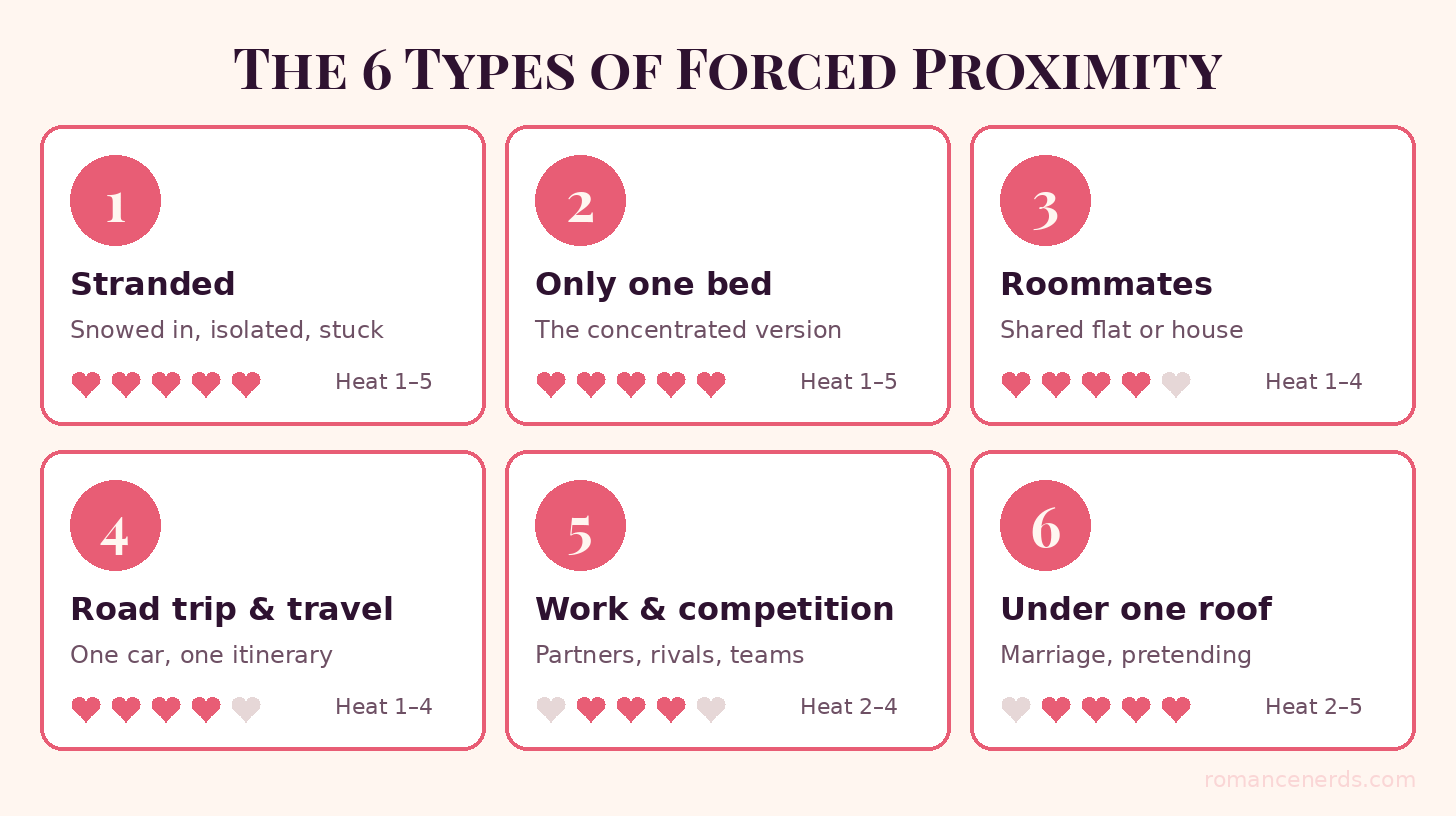
These are the six setups I see most often. Most books blend two or three. Heat ranges are typical ranges on my romance spice scale, not rules.
1. Stranded: Snowed In, Isolated or Stuck Somewhere
What it is: The setting traps them, whether it’s a blizzard, a remote cabin, a broken-down car, a storm, or an island.
Why it works: Nature takes the decision out of their hands. The isolation makes everything feel more intense, and there’s often a cozy, survival-adjacent closeness (one fire, shared blankets).
Typical heat range: 🌶️ to 🌶️🌶️🌶️🌶️🌶️. Cozy snowed-in romances can be sweet, while isolated dark romances sit at the top.
Example: Credence by Penelope Douglas, a remote Colorado cabin and a very dark take on isolation (heavy content warnings).
2. Only One Bed
What it is: The famous microtrope. There’s one bed, someone offers to sleep on the floor, and the other one says something like “don’t be ridiculous.”
Why it works: It’s the most concentrated version of forced proximity: a few inches of space and a lot of awareness. It often sparks the first honest late-night conversation.
Typical heat range: 🌶️ to 🌶️🌶️🌶️🌶️🌶️. In sweet romance the tension stays tension, while in spicier books it’s often the turning point.
Example: The Unhoneymooners by Christina Lauren. Sworn enemies Olive and Ethan end up sharing a honeymoon suite in Maui.
3. Roommates and Shared Living
What it is: They share a home, a flat or a house, by necessity, money troubles, or a housing mix-up.
Why it works: It’s the long game. Characters see each other’s routines, habits and vulnerabilities over weeks or months, which makes the eventual relationship feel deeply earned.
Typical heat range: 🌶️ to 🌶️🌶️🌶️🌶️.
Example: The Flatshare by Beth O’Leary. Tiffy and Leon share a one-bed flat on opposite schedules and get to know each other through notes before they ever properly meet.
4. Road Trips and Travel
What it is: A journey traps them in the same car, hotel or itinerary, whether that’s a wedding abroad, an annual trip, or a honeymoon gone wrong.
Why it works: Travel strips away routine and adds new scenery, shared mishaps and hotel-room logistics. Plus, the trip has an end date, which adds urgency.
Typical heat range: 🌶️ to 🌶️🌶️🌶️🌶️.
Examples:
People We Meet on Vacation by Emily Henry: best friends whose annual summer trips hold their story together.
The Spanish Love Deception by Elena Armas: a fake date to a family wedding in Spain.
5. Work Assignments and Competition Partnerships
What it is: A job, project, team or competition forces them to work closely together: a shared office, skating partners, camp counselors, orchestra rivals.
Why it works: Competence and rivalry go well together. Working side by side shows each character’s best (and most stubborn) self, and professional boundaries add a forbidden edge.
Typical heat range: 🌶️🌶️ to 🌶️🌶️🌶️🌶️.
Examples:
The Hating Game by Sally Thorne: rivals sharing an office.
From Lukov with Love by Mariana Zapata: longtime rivals become figure-skating partners for one season.
Wildfire by Hannah Grace: summer-camp counselors under a no-fraternizing rule.
Not Another Love Song by Julie Soto: rivals in the same orchestra.
6. Marriage, Arrangements and Pretending Under One Roof
What it is: A marriage of convenience, an arranged engagement, or a “we have to pretend we’re still together” situation that puts them in shared space.
Why it works: It has all the intimacy of a relationship with none of the emotional security. Every day of pretending, or of being married on paper, blurs the line between real and fake.
Typical heat range: 🌶️🌶️ to 🌶️🌶️🌶️🌶️🌶️.
Examples:
Happy Place by Emily Henry: exes pretending they’re still a couple during a week with their friends.
King of Wrath by Ana Huang: an arranged engagement between Dante and Vivian.
Bride by Ali Hazelwood: a vampire-werewolf political marriage.
Forced Proximity Romance Books I’d Recommend, by Spice Level
Here are the books above sorted by heat. These placements are approximate, because spice is subjective. Check reader ratings on sites like romance.io and content warnings before you start. For more on what each level means, see my spice scale guide.
Lower heat (around 1–2 peppers):
The Flatshare by Beth O’Leary (roommates)
People We Meet on Vacation by Emily Henry (travel)
Not Another Love Song by Julie Soto (work partnership)
From Lukov with Love by Mariana Zapata (skating partners, a famously slow burn)
Medium heat (around 3 peppers):
The Unhoneymooners by Christina Lauren (one suite)
Happy Place by Emily Henry (pretending under one roof)
The Hating Game by Sally Thorne (shared office)
The Spanish Love Deception by Elena Armas (travel and fake dating)
Wildfire by Hannah Grace (summer camp)
King of Wrath by Ana Huang (arranged engagement)
High heat (4–5 peppers):
Bride by Ali Hazelwood (political marriage)
Credence by Penelope Douglas (stranded, dark, heavy content warnings)
For even more high-heat reads, see my list of the spiciest books readers are talking about in 2026.
Forced Proximity + Other Tropes: The Best Pairings
Forced proximity is rarely the only trope in a book. It works more like a pressure cooker you can put other tropes inside. These are the combinations I find hardest to resist:
Forced proximity + enemies to lovers: nowhere to hide from someone you claim to hate. The Hating Game and The Unhoneymooners both do this. If you want to write one, my enemies-to-lovers prompts include plenty of trapped-together setups.
Forced proximity + fake dating: pretending in public and then being alone together in private. The Spanish Love Deception and Happy Place both use this.
Forced proximity + slow burn: the longer they’re stuck together without anything happening, the more every glance matters. From Lukov with Love is the classic reader pick here.
Forced proximity + grumpy/sunshine: one of them hates sharing space and the other turns it into a home.
Forced proximity + morally grey: a darker version, where being trapped with someone dangerous is the whole point. It works best when the book is upfront about it. I explore why readers love these characters in Morally Grey Characters.
How to Write Forced Proximity Without It Feeling Contrived
If you’re writing your own, these are the things I think make the difference:
Make the reason airtight. Give characters a believable reason they can’t just leave: money, weather, a contract, a lie they can’t take back, a competition they both need to win. If readers think “why not get another room?”, you’ve lost them.
Give them a reason to stay, not just a reason they can’t go. The best setups mix outside pressure with something each character wants.
Use the space. Close quarters should create specific moments: a shared bathroom routine, a too-small couch, a single blanket. Specific details make the tension real.
Let proximity reveal character. What do they do at 2 a.m.? How do they act when they think the other one’s asleep? That’s where readers fall in love.
Escalate the closeness. Start with distance (separate rooms, strict rules) and slowly remove the buffers until only one bed is left, literally or emotionally.
Respect consent and comfort. Even in high-heat books, the strongest scenes show both characters choosing closeness, not just being pushed into it.
Pay off the pressure. You’ve spent the book building tension in a small space, so make the release feel worth it.
If you’d rather read a “snowed in, one bed” scenario written to your own heat level than write it yourself, my AI romance story generator roundup compares the tools that let you set tropes and spice.
Forced Proximity FAQ
What does forced proximity mean in books?
It means two characters are kept physically close by circumstances they didn’t choose, such as sharing a home, being stranded, traveling together or working side by side. Their romance develops because they can’t easily walk away.
Is only one bed the same as forced proximity?
Not quite. Only one bed is a microtrope inside forced proximity. Forced proximity is the larger situation, and only one bed is its most concentrated moment.
What are good forced proximity romance books?
A few to start with are The Flatshare by Beth O’Leary (roommates), The Unhoneymooners by Christina Lauren (one honeymoon suite), From Lukov with Love by Mariana Zapata (skating partners) and The Hating Game by Sally Thorne (shared office).
Is forced proximity spicy?
It can be, but it doesn’t have to be. Forced proximity is about the setup, not explicitness, so you’ll find it everywhere from sweet romance to five-pepper dark romance.
What’s the difference between forced proximity and enemies to lovers?
Enemies to lovers is about the relationship (they start out opposed). Forced proximity is about the situation (they can’t get away from each other). They’re often paired together.
Why do readers love forced proximity?
Because it removes the easy escape. Characters have to talk, notice and reveal themselves, and the tension builds until it has to break.
What are examples of forced proximity setups?
Snowed in or stranded, only one bed, roommates, road trips, work or competition partnerships, and marriages or arrangements that put two people under one roof.
The Bottom Line
Forced proximity works because it takes away the one thing people use to avoid their feelings: distance. Whether it’s a shared flat, a honeymoon suite or a remote cabin, the trope traps two characters until honesty is the only way out. That’s why it’s in my S tier. If you want to see where it sits among the other tropes, my romance tropes list has the full ranking.
Which forced proximity setup is your favorite? Reply and tell me. And if you enjoyed this, subscribe to Romance Nerds for more trope deep-dives.
Sources
Book details were checked against publisher, author, Kirkus or All About Romance pages, including christinalaurenbooks.com (The Unhoneymooners), Kirkus (The Unhoneymooners), All About Romance (From Lukov with Love), Hachette (Not Another Love Song), Simon & Schuster (Wildfire), anahuang.com (King of Wrath), alihazelwood.com (Bride), pendouglas.com (Credence) and sallythorneauthor.com (The Hating Game).