

By Alma Martin · Trope guide · October 2026
Disclosure: Near the end, this guide links once to my post on whether AI can write good smut. Some tools mentioned on this site have affiliate links, and if you sign up through one I may earn a commission at no extra cost to you. Nothing in this guide is sponsored.
What does slow burn mean in books? A slow burn romance takes its time. The attraction builds gradually over most of the book, and the first kiss, confession or getting together comes late, sometimes very late. Slow burn is about pacing, not spice. A slow burn can stay completely closed door, or it can end in a five-pepper payoff. That’s why I’ve split my recommendations below into slow burn romance books without spice and with spice.
Slow burn sits in my S tier in my romance tropes tier list. For me, nothing in romance beats the feeling of a payoff that’s been building for hundreds of pages. This guide covers what slow burn means, how to tell a slow burn from a fast burn before you start, two separate book lists, what makes a slow burn satisfying, and the tags to search if you read fanfiction.
Key takeaways:
Slow burn = slow pacing. The relationship develops gradually and the payoff arrives late.
It isn’t a spice level. Slow burns range from sweet and closed door to very explicit.
The opposite is fast burn, or insta-love, where attraction and action come early.
What makes it work: steady escalation, real obstacles, and a payoff that feels earned.
How to spot one: look for “slow burn,” “yearning” or “pining” in descriptions and reviews, and check spice ratings separately.
Fanfiction readers can filter AO3 by the “Slow Burn” tag.
What Does Slow Burn Mean in Romance?
My one-line definition: a slow burn is a romance where the getting-together is delayed, deliberately, so the tension has time to build.
In a slow burn, the characters might notice each other early, but the story keeps them apart, or keeps them from admitting anything, for a long time. The obstacles vary: rivalry, misunderstanding, duty, timing, fear, or simply two stubborn people who refuse to say it first. Readers often describe slow burns with words like yearning, pining and longing, because that’s what most of the book feels like.
A few things slow burn is not:
It’s not “nothing happens.” A good slow burn is full of small moments: a look held too long, an accidental touch, a conversation that almost goes somewhere.
It’s not a spice level. The romance spice scale measures how explicit a book is. Slow burn measures when things happen.
It’s not one fixed length. Some readers call a book slow burn if the first kiss lands halfway through. Others reserve the term for books where it happens in the final chapters, or not until book two.
Slow Burn vs Fast Burn: How to Tell Before You Start
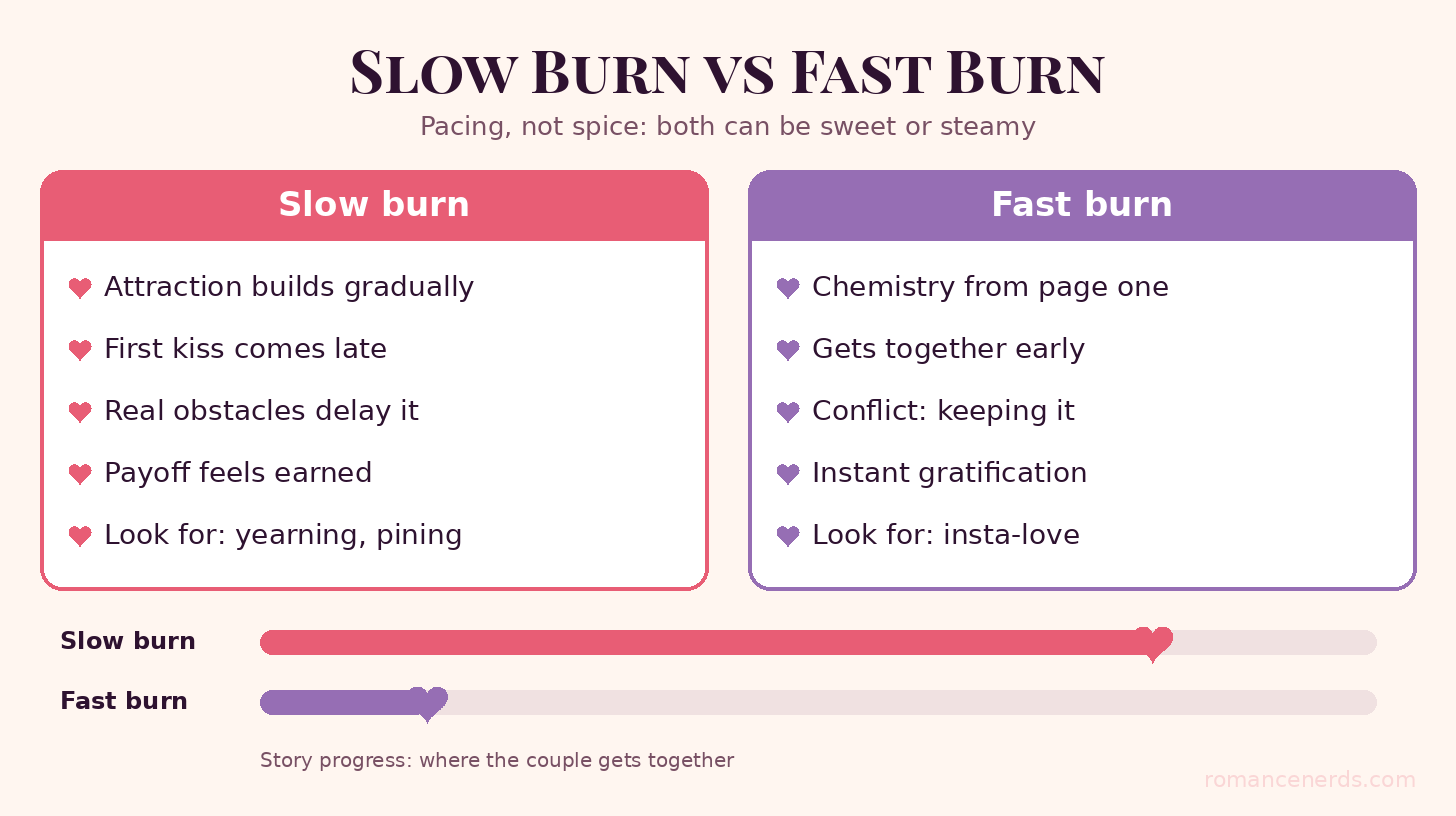
The opposite of a slow burn is a fast burn, where the attraction is immediate and the relationship moves quickly. At the far end is insta-love, love at first sight. Neither is better. They just give you different pleasures.
Signs a book is a slow burn:
The description or reviews mention “slow burn,” “yearning,” “pining” or “worth the wait.”
The leads start out as rivals, enemies, coworkers or friends rather than strangers who hit it off.
There’s a strong outside obstacle (a competition, a job, a war, a rule) that keeps them apart.
Reader reviews mention how long it takes for the first kiss.
It’s the first book in a series that follows the same couple. Romantasy series often stretch the burn across books.
Signs a book is a fast burn:
Words like “instant chemistry,” “insta-love” or “one-night stand” appear in the description.
The couple gets together early, and the main conflict is keeping the relationship rather than starting it.
Spice appears in the first few chapters.
My tip: check the pacing and the spice separately. Reader reviews and sites like romance.io often say how slow a book is and how spicy it is, and those are two different questions.
Why I Love a Slow Burn (and Why Readers Keep Asking for It)
These are the reasons I think slow burn hits so hard:
The payoff feels earned. When two characters finally get together after 300 pages of resistance, it feels like a reward for them and for you.
Anticipation is half the pleasure. Waiting for something can be as enjoyable as getting it, and slow burns stretch that feeling out.
Small moments become huge. In a slow burn, a hand on the small of a back can feel like the most romantic thing that’s ever happened.
The characters grow first. There’s time for both people to change, which makes the relationship feel more believable.
It’s built for rereading. Once you know how it ends, you can go back and spot every early sign you missed.
Slow Burn Romance Books Without Spice
These are slow burns that keep things closed door, or close to it. They’re good if you want all the yearning and none of the explicit scenes. Spice ratings are approximate and readers’ ratings vary, so check romance.io or reader reviews if you’re sensitive to content.
Pride and Prejudice by Jane Austen. The original slow burn for many readers: first impressions go badly, pride and misunderstanding keep Elizabeth and Darcy apart, and the payoff takes nearly the whole book. Closed door.
Heartstopper by Alice Oseman. A sweet graphic-novel series about Charlie and Nick, whose friendship slowly becomes something more. Very low heat.
Legends & Lattes by Travis Baldree. A cozy fantasy about an orc warrior opening a coffee shop. The romance is a quiet, gentle thread rather than the main event. Very low heat.
The Flatshare by Beth O’Leary. Tiffy and Leon share a one-bed flat on opposite schedules and get to know each other through notes long before they properly meet. Low heat.
People We Meet on Vacation by Emily Henry. Best friends whose annual summer trips span years of almost-but-not-quite. Low to moderate heat.
From Lukov with Love by Mariana Zapata. Longtime rivals become figure-skating partners for one season. Zapata is known among readers for very slow burns, and this one is low on spice.
Slow Burn Romance Books With Spice
These slow burns make you wait, but they open the door once things finally happen. Heat levels are approximate.
Not Another Love Song by Julie Soto. Rivals in the same orchestra whose musical chemistry builds before the romance does. Around 2 peppers.
The Hating Game by Sally Thorne. Office rivals Lucy and Josh spend most of the book in a war of one-upmanship before the tension breaks. Around 3 peppers.
The Love Hypothesis by Ali Hazelwood. A fake-dating setup between grad student Olive and the notoriously grumpy Adam, with feelings creeping in slowly. Around 3 peppers.
Wild Love by Elsie Silver. Ford and Rosie’s forbidden attraction (she’s his best friend’s sister) simmers before it ignites. Around 4 peppers.
A Court of Mist and Fury by Sarah J. Maas. The second book in the series, where the romance with Rhysand builds slowly after the first book. Readers often describe it as the payoff of a series-long burn. Around 4 peppers.
Throne of Secrets by Kerri Maniscalco. Enemies-to-lovers romantasy between Gabriel Axton, the Prince of Gluttony, and journalist Adriana Saint Lucent. Around 4 peppers.
Want more heat? My list of the spiciest books readers are talking about in 2026 is sorted by pepper level.
What Makes a Slow Burn Satisfying
Not every slow burn works. These are the things I think separate a great one from a frustrating one:
Steady escalation. The tension has to keep rising. Each chapter should move them slightly closer, even if it’s just one more honest conversation.
A real reason for the delay. “They just didn’t talk” gets old fast. Rivalry, duty, grief, a competition or a genuine fear of losing a friendship give the wait meaning.
Moments that pay off along the way. Readers need small rewards: an almost-kiss, a protective gesture, a confession that’s interrupted.
Chemistry from the start. Even if nothing happens for 300 pages, the reader should feel the pull early.
A payoff worth the wait. This is the big one. If the getting-together is rushed or happens off-page after all that buildup, it can feel like a cheat.
Pacing after the payoff. The best slow burns leave time after the couple gets together for the relationship to breathe, instead of ending immediately.
When it doesn’t work, for me: when the delay comes from repetitive miscommunication, when the tension plateaus for a hundred pages, or when the payoff is a single paragraph.
Slow Burn Pairs Best With These Tropes
Slow burn is a pacing choice, so it combines with almost any trope. These are the pairings I find hardest to resist:
Slow burn + enemies to lovers: the hostility gives the delay a reason, and every argument adds fuel.
Slow burn + forced proximity: being stuck together without anything happening makes every moment matter. See my guide to the forced proximity trope.
Slow burn + friends to lovers: the fear of losing the friendship is a powerful brake.
Slow burn + marriage of convenience: married on paper, falling for each other in real time.
Slow burn + morally grey: a guarded love interest who takes the whole book to let anyone in. I explore why readers love these characters in Morally Grey Characters.
Slow Burn in Fanfiction: Tags to Search
Fanfiction readers have been filtering for slow burn for years. On Archive of Our Own (AO3), these are the tags to look for:
Slow Burn: the main tag, used by authors who want readers to know the payoff is coming late.
Pining and Mutual Pining: both characters want each other and neither says anything.
Friends to Lovers and Enemies to Lovers: common partners for slow burn.
Eventual Romance: another way authors signal a delayed relationship.
Combine these with a rating filter (General, Teen, Mature, Explicit) to set your heat level. Tags are added by authors, so a “slow burn” tag can mean different speeds in different stories. For more on what AO3 tags reveal about readers, see what 18 million fanfics tell us about what romance readers want.
If you write your own slow burn: be careful with AI tools. In my experience they tend to rush the payoff, because they’re built to give you what you asked for straight away. I wrote about their limits in can AI write good smut?. If you want a starting point, my enemies-to-lovers prompts are a natural slow burn fit.
Slow Burn Romance FAQ
What does slow burn mean in books?
It means the romance develops gradually, and the first kiss, confession or relationship comes late in the story. It’s about pacing, not spice.
Does slow burn mean no spice?
No. A slow burn can be closed door or very explicit. The difference is that the spice, if there is any, comes later in the book.
What’s the opposite of slow burn?
Fast burn, where attraction and action come early. At the extreme end is insta-love.
How long is a slow burn?
There’s no set length. Some readers count a first kiss halfway through as slow burn, while others mean the final chapters, or even a later book in the series.
What are good slow burn romance books without spice?
Pride and Prejudice by Jane Austen, Heartstopper by Alice Oseman, The Flatshare by Beth O’Leary and From Lukov with Love by Mariana Zapata are good places to start.
What are good slow burn romance books with spice?
The Hating Game by Sally Thorne, The Love Hypothesis by Ali Hazelwood, Wild Love by Elsie Silver and A Court of Mist and Fury by Sarah J. Maas.
What does slow burn mean in fanfiction?
The same thing: a delayed romance. On AO3, look for the “Slow Burn,” “Pining” and “Mutual Pining” tags.
Why do people like slow burn romance?
The payoff feels earned, anticipation is part of the pleasure, and the characters have time to grow before they get together.
The Bottom Line
Slow burn is the trope that makes you wait, and that’s exactly why it’s so satisfying. With or without spice, the best slow burns turn every small moment into a big one and save the payoff until you’re desperate for it. If you want to see where slow burn sits among all the other tropes, my romance tropes list has the full ranking.
What’s the slowest burn you’ve ever loved? Reply and tell me. And if you enjoyed this, subscribe to Romance Nerds for more trope deep-dives.
Sources
Book details were checked against publisher, author, Kirkus, Goodreads or All About Romance pages, as listed in the Romance Tropes List and Forced Proximity drafts. Pride and Prejudice, Heartstopper and Legends & Lattes are widely documented.